



Climate Ministry Shares GCF and GEF Projects but Not Full Donor Wise Fund Breakup
Nadeem Tanoli
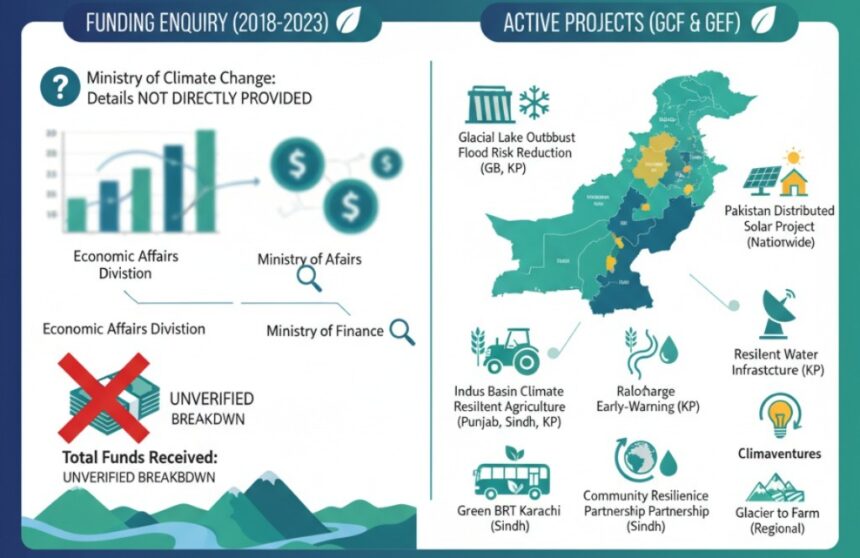
Islamabad: The Senate was informed that full details of climate change funds received by Pakistan during the last five years were not directly provided by the Ministry of Climate Change and Environmental Coordination and may be obtained from the Economic Affairs Division and Ministry of Finance. However, Climate Change Minister Mr. Musadik Masood Malik placed before the House details of Green Climate Fund and Global Environment Facility projects being processed by the Climate Finance Wing, covering flood protection, solar energy, climate-smart agriculture, clean transport, water management, renewable energy and community resilience.
The details were shared in response to Question No. 7 raised by Senator Dr. Zarqa Suharwardy Taimur. She asked whether Pakistan had received around $2 billion per year for climate change initiatives during the last five years. She also sought donor wise, year, project, province wise details, along with the mechanism for allocation, monitoring and evaluation of climate funds.
In his reply, Mr. Musadik Masood Malik stated that details of funds received by the Government of Pakistan during the last five years may be obtained from the Economic Affairs Division and Ministry of Finance. This means the Climate Change Ministry did not directly provide a full year wise breakup of total climate funds, donor agencies, donor countries or complete utilization details to the Senate.
Instead, the ministry shared details of projects under the Green Climate Fund and Global Environment Facility being processed in the Climate Finance Wing. These projects cover different parts of Pakistan and include flood risk reduction, climate resilient farming, solar financing, clean transport, water infrastructure, clean energy and environmental protection.
The largest Green Climate Fund linked figure placed before the Senate was the overall project pipeline of $6.458 billion, while Pakistan’s share in relevant regional projects was shown at $295.43 million. Total GCF financing was listed at $866.78 million, with Pakistan’s share shown at $331.7 million. This shows that several projects are regional or multi country facilities, where only a portion belongs to Pakistan.
A major project listed was “Scaling up of Glacial Lake Outburst Flood Risk Reduction in Northern Pakistan,” implemented with UNDP in Gilgit Baltistan and Khyber Pakhtunkhwa. The project was designed to reduce the danger of sudden floods from melting glaciers and mountain lakes. According to the official record, 250 engineering structures, including dams, ponds, spillways, tree plantation and drainage works, were built to reduce risk.
Another key project was “Transforming the Indus Basin with Climate Resilient Agriculture and Climate Smart Water Management,” implemented with FAO in Punjab and Sindh. The project aims to help Pakistan use modern information and technology to deal with the impact of climate change on agriculture and water management.
The “Green BRT Karachi” project, supported by ADB, was also included. It aims to establish a 30 kilometre fully separated bus rapid transit system in Karachi using a biomethane hybrid bus fleet. The project is designed to reduce pollution and avoid millions of tons of emissions.
The Pakistan Distributed Solar Project, linked with JS Bank, aims to provide financing solutions for distributed solar products so people and businesses can invest in solar power. The “Recharge Pakistan” project, implemented with WWF in Balochistan, Sindh and Khyber Pakhtunkhwa, focuses on flood and water resource management through nature-based solutions in the Indus Basin.
The Community Resilience Partnership Regional Program, supported by ADB, includes Pakistan’s share in Sindh and focuses on vulnerable communities. The Acumen Climate Action Pakistan Fund aims to help vulnerable farmers access climate adaptation solutions. The WFP project in Buner and Shangla districts of Khyber Pakhtunkhwa aims to strengthen flood early-warning systems and climate information services.
The Resilient Water Infrastructure Facility, linked with IFC, was listed as a long-term facility for Pakistan. It includes support for public-private partnership structuring, project preparation, advisory work and concessional co-investments for water infrastructure projects.
The Climaventures project, linked with NRSP, aims to create a climate action venture studio in Pakistan, including support for women, persons with disabilities and transgender entrepreneurs. The “Glacier to Farm” regional programme, supported by ADB, aims to improve the resilience of communities, food systems and social infrastructure in Central and West Asia, including Pakistan.
The ministry also provided details of Global Environment Facility projects. The total budget of these GEF projects was shown at $77.22 million, with GEF financing of $11.3 million. These include a UNDP project on sustainable biomass energy in Punjab, Khyber Pakhtunkhwa, Sindh and Balochistan, and a UNIDO project in Islamabad on low-carbon circular economy and clean technology innovation.
A FAO backed project in Attock, Chakwal and Jhelum focuses on combating land degradation through sustainable range and livestock management. Another FAO project in Sindh, titled “Bananas in Pakistan’s Bioeconomy: Transforming Waste into Textile,” focuses on turning banana waste into useful material for the textile sector.
The Senate reply shows that Pakistan has several climate-related projects in the pipeline, but the main question about total foreign climate funds, donor-wise details, year wise inflows and full utilization was not answered directly by the Climate Change Ministry. Instead, the ministry referred the matter to the Economic Affairs Division and Ministry of Finance for complete fund receipt details.
Copied From: Climate Ministry Shares GCF and GEF Projects but Not Full Donor Wise Fund Breakup