



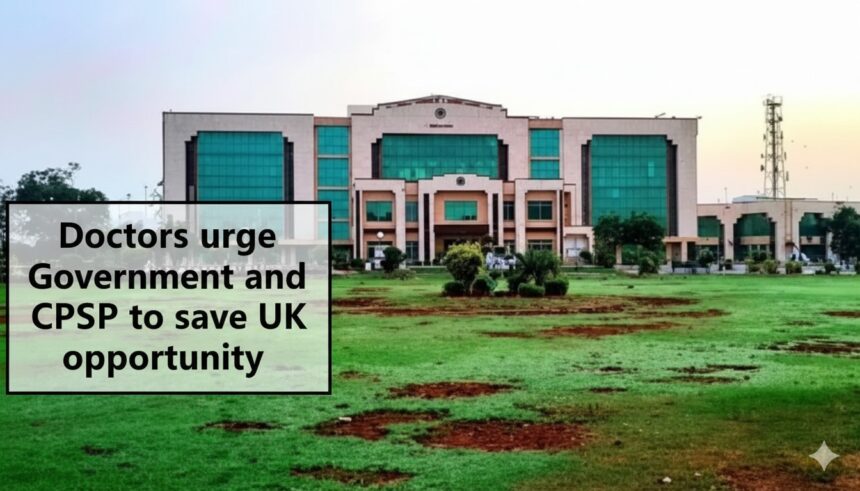
Doctors urge Government and CPSP to save UK opportunity
Islamabad (Nadeem Ch) The College of Physicians and Surgeons Pakistan (CPSP), the country’s apex postgraduate medical body, is facing intensifying criticism over what doctors and analysts describe as a systemic failure to protect the future and international employability of Pakistani medical graduates.
CPSP was established with a clear mandate to produce specialists whose qualifications would be competitive and acceptable internationally. In practice, critics argue, that mandate has been gravely undermined by weak governance and an inward-looking institutional culture that has failed to anticipate global regulatory, ethical, and reputational standards.
CPSP functions as the custodian of postgraduate medical training and, by extension, the employability of its graduates. However the CPSP has failed to secure meaningful international acceptance of FCPS, particularly in the UK and United States, where Pakistani doctors continue to face repeated examinations, licensing barriers, and exclusion from consultant-level appointments. Medical associations argue that this defeats the very purpose for which CPSP was created.
The recent collapse of CPSP’s collaboration with University Hospitals Birmingham (UHB) UK is now widely viewed as a symbol of institutional incompetence of CPSP rather than an unavoidable external shock.
The CPSP program of UHB International Training Fellows (ITF) program was regarded as one of the most valuable international pathways ever available to Pakistani postgraduate doctors. It should, critics argue, have been protected “at all costs.” Instead, due to CPSP’s failure to rigorously vet contractual structures by ensuring compliance with UK employment and tax law and failure to instill watertight legal protections for its trainees, the program became vulnerable to audit, legal challenge, and ultimate termination.
Following a devastating KPMG audit, UHB terminated the scheme, severed ties with CPSP, and withdrew from NHS England’s international recruitment framework. Over 700 Pakistani doctors were caught in the fallout. Observers stress that it was CPSP’s duty to draft and negotiate flawless terms and conditions, anticipating audits and regulatory scrutiny. The failure to do so, they argue, constitutes gross negligence.
CPSP now has the duty to challenge the KPMG audit and the UHB in the appropriate UK court and get the program revived or the CPSP Leadership can resign as failure to act by the CPSP will do irreparable harm to the Pakistani doctors. University Hospitals Birmingham (UHB) must be urged by the CPSP to challenge the KPMG audit as well rather than accepting it.
Critics argue that University Hospitals Birmingham (UHB) appears to have opportunistically used the KPMG audit as a pretext to abruptly exit the agreement and disengage from Pakistani doctors, rather than subjecting the audit findings to challenge, clarification, or corrective action. Instead of addressing governance gaps while safeguarding trainees, UHB moved decisively to terminate the partnership, a step that effectively removed hundreds of Pakistani doctors from the program with minimal consequence to the UK institution itself.
Pakistani doctors and legal experts maintain that while CPSP bears responsibility for inadequate contractual safeguards, the termination has disproportionately harmed Pakistani trainees and CPSP, not UHB or the UK health system. By swiftly dissolving the agreement, UHB insulated itself from scrutiny and liability, while the burden of the fallout was transferred entirely onto foreign doctors who had entered the scheme in good faith.
“This was an institutional partnership, not an informal arrangement,” said a senior clinician familiar with the matter. “CPSP was obligated to protect its trainees—and it failed while UHB also chose the path of expedience over fairness, abandoning the doctors instead of fixing any faults in the paperwork.”
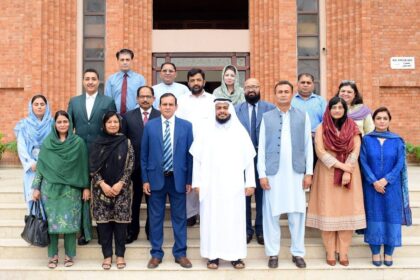
Beyond technical failures, critics also point to CPSP’s lack of international outlook and external representation. In an era where global medical institutions emphasize diversity, international collaboration, and cross-border credibility, CPSP’s leadership structure is seen as insular and disconnected from Western customs and academic norms. Doctors urge the Government to examine the getup and appearance of the CPSP leadership as it may find it appropriate to engage with western authorities while analysts warn that appearances of emissaries and perceptions matter in international accreditation, reciprocity, and trust. “The present leadership of CPSP even by its mere appearance does not reflect global engagement nor projects confidence to international regulators;” said a senior Professor “This directly harms the image of progressive Pakistani doctors abroad striving in a tough job market.”
Experts reiterate that CPSP must acknowledge its mistakes and learn from it. CPSP must position FCPS for direct consultant-level recognition without any examinations in the UK and US and middle east, and FCPS be accepted as comparable qualifications in these jurisdictions as this is the foremost duty of CPSP. For this purpose CPSP should urgently appoint external examiners approved by UK and US academic and accrediting bodies, and align its curricula and assessments transparently and perfectly with international UK USA standards, CPSP has to strike reciprocity mechanisms explicitly envisaged under the PMDC Act 2022.Failure to do so, they warn, will permanently marginalize FCPS holders.
Compounding the crisis is the continued inclusion of Pakistan on the WHO Health Workforce Support and Safeguards (Red) List. “The Red List was meant as a reference to encourage governments in countries to strengthen their health systems by creating sufficient posts and working conditions so that populations can be adequately served, commonly referenced as achieving at least one doctor per 1,000 population. The intent of the Red List was system strengthening, not the restriction of individual livelihoods. Where governments fail to create adequate job opportunities despite producing qualified doctors, the ethical burden cannot be shifted onto those doctors, who must secure employment in order to sustain themselves and their families. In such circumstances, doctors are compelled to seek work elsewhere as a matter of survival, not choice. The Red List must therefore not be misused by destination western countries as a tool to deny fair and ethical employment opportunities to doctors from listed countries, particularly where unemployment or underemployment exists. Ethical recruitment safeguards are meant to protect fragile health systems, not to penalize individual professionals for systemic policy failures, nor to function as a mechanism of labor market exclusion.The government and CPSP have failed to defend these principles.”
Pakistan has a doctor-to-population ratio (~1.1–1.15 per 1,000) comparable to India (~1.2), with rising unemployment and underemployment among doctors, and evidence that migration reflects labor mobility, not “brain drain,” but neither CPSP nor the Ministry of National Health Services has mounted an effective challenge to Pakistan’s listing in the red list of the WHO.
Critics argue that this policy inertia has directly harmed Pakistani doctors, allowing Western countries to cite the Red List as justification for exclusion, despite domestic saturation and lack of jobs.
Medical bodies and senior clinicians are now openly calling for resignation of CPSP’s president and senior leadership for failure to protect trainees and qualifications.
As previously reported by multiple outlets, including Daily The Destination and Islamabad Mail, CPSP’s credibility crisis has been building for years. The Birmingham scandal, critics say, is not an anomaly but an inevitable consequence of sustained misgovernance.
For thousands of Pakistani doctors, the cost is personal and irreversible: lost opportunities, stalled careers, and reputational harm abroad.
Unless urgent reforms are undertaken, experts warn that CPSP risks becoming an examining body without global relevance, presiding over qualifications that no longer deliver what they promise.And for a profession already facing unemployment at home and barriers abroad, that failure may prove catastrophic.
All efforts were made to contact President CPSP but no response was received from him.
Read in Urdu: سی پی ایس پی کی ناکامی، پاکستانی ڈاکٹروں کے برطانیہ میں مواقع خطرے میں