



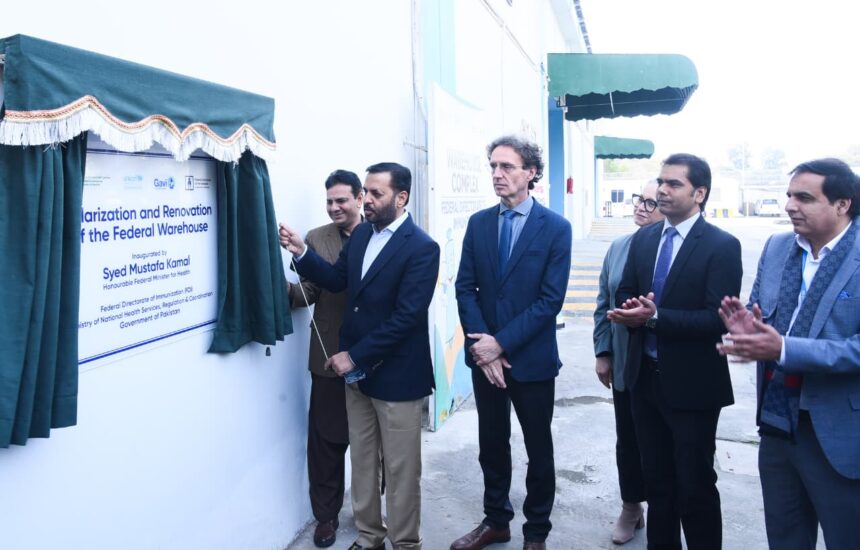
The Federal Minister for Health, Syed Mustafa Kamal, inaugurated a 1 megawatt solar power system at the EPI Warehouse today in partnership with UNICEF, a step aimed at strengthening Pakistan’s vaccine cold chain and building a more resilient health infrastructure.
“With the generation of 1 megawatt of electricity, vaccines will remain safe even in emergencies or power outages,” Mr. Mustafa Kamal said, stressing that uninterrupted cold chain maintenance is essential to safeguard millions of children across the country.
The Minister thanked Gavi and other international development partners for their support in operationalizing the solarization system, calling the project a prime example of effective collaboration between the Government of Pakistan and development partners.
Mr. Mustafa Kamal reiterated that improving Pakistan’s health system is a top government priority, saying, “We aim to transform the system from sick care to true healthcare. Vaccination is the first and most effective step toward preventing future diseases.” He noted that while global immunization programmes cover up to 50 vaccine-preventable diseases and Saudi Arabia protects against 47, Pakistan currently vaccinates against 13 diseases under its national programme, all provided free by the government, and has added the cervical cancer (HPV) vaccine to the schedule.
The Minister highlighted vaccine financing challenges, noting that Pakistan presently funds 49 percent of vaccine costs while 51 percent is supported by global donors. With anticipated global assistance ending by 2030, Pakistan’s vaccine bill could rise from USD 400 million to about USD 1.2 billion, a jump that will require strategic planning and sustainable investment to manage.
Describing health as a matter of national security, Mr. Mustafa Kamal recalled how countries from the United States to China struggled during the COVID-19 pandemic and cited World Health Organization estimates that around 13 million Pakistanis were pushed below the poverty line by illness-related expenses.
He also underlined that healthcare begins at birth and that building hospitals alone does not constitute a full health system, emphasizing preventive measures as the priority. The Minister reported that 11,600 citizens in Islamabad, Azad Jammu & Kashmir and Gilgit-Baltistan have benefited from the Universal Health Insurance scheme, and that the Prime Minister recently launched the Health Card initiative while treatment capacity has been expanded to 13 additional hospitals to ease pressure on PIMS and Polyclinic.
Dr. Musa Khan, Director General of the Federal Directorate of Immunization, said the solarization and renovation of the vaccine warehouse is a transformative step in modernizing Pakistan’s immunization programme and that continuous cold chain maintenance will help keep vaccines potent and effective despite challenges.
Dr. Gunter Boussery, Chief of Health Section at UNICEF Pakistan, added that UNICEF is proud to support Pakistan in strengthening its cold chain system and that introducing sustainable solar energy solutions protects vaccines while investing in the long-term health and future of every child in the country.