



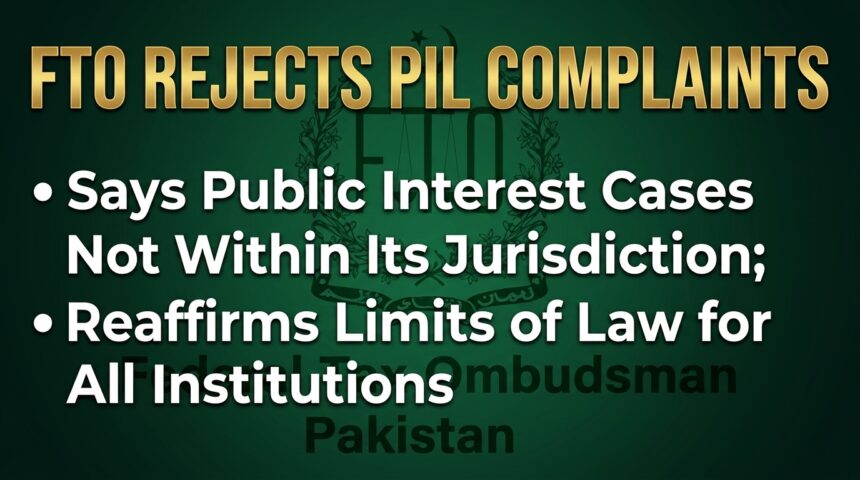
ISLAMABAD: The Federal Tax Ombudsman (FTO) has ruled that it does not have jurisdiction to hear Public Interest Litigation (PIL) matters, saying such cases fall under constitutional courts and not administrative forums.
In a detailed judgment in Complaint Nos. 01540, 01545 and 01550/LHR/IT/2026, the FTO said it is empowered to deal with tax maladministration and individual grievances, but cannot take up broader public interest cases outside its legal mandate under the Federal Tax Ombudsman Ordinance, 2000.
The complaints were filed as Public Interest Litigation involving general allegations of maladministration in tax affairs. The order said these were not taxpayer specific grievances and therefore could not be examined by the Ombudsman.
The judgment further noted that Public Interest Litigation is a constitutional mechanism belonging to superior courts, not statutory bodies like the FTO. It also explained that tax complaints must relate to specific individuals or identifiable grievances, and cannot be treated as general policy challenges or system wide accusations.
The Ombudsman said every institution in Pakistan must act strictly within the powers given by law. It added that even well meaning interventions cannot go beyond the jurisdiction granted by Parliament.
At the same time, the office clarified that where superior courts refer matters involving maladministration, the FTO remains fully empowered to investigate those cases under law.
In its remarks, the FTO stressed that jurisdiction is the foundation of all judicial and quasi judicial bodies. It said respecting legal limits is not a restriction but a requirement of constitutional governance.
The complaints were rejected for lack of jurisdiction, but the decision also offers guidance for future cases on the difference between individual tax grievances and public interest matters.
The ruling is expected to serve as a reference for taxpayers, tax authorities and future complainants on how cases should be filed under the law.
Conclusion: With this decision, the Federal Tax Ombudsman has reaffirmed that public institutions must function within their defined legal boundaries, while constitutional courts remain the proper forum for public interest litigation.