



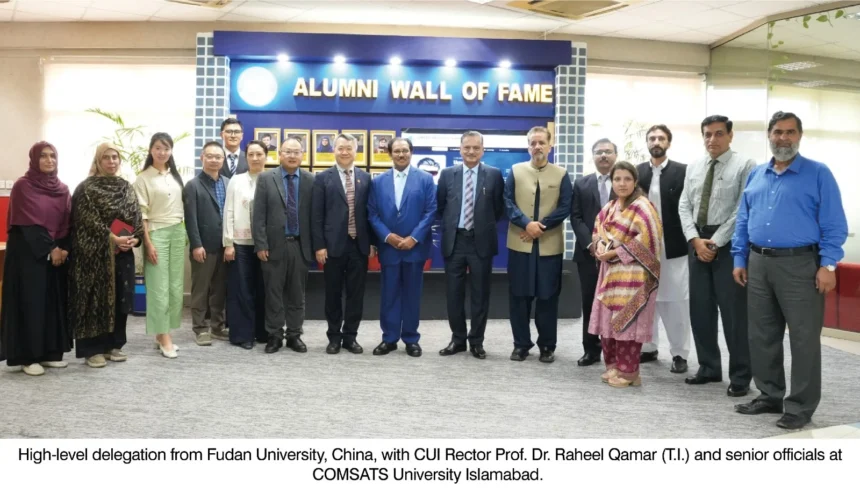
ISLAMABAD: A high-level delegation from Fudan University, China, accompanied by Dr Zafar Uddin Mahmood, Prime Minister’s Special Representative to China for Trade, Investment and Economic Cooperation, visited COMSATS University Islamabad (CUI) on Monday to explore new avenues of cooperation in higher education, research, faculty and student mobility, joint academic programmes and cultural exchange.
The delegation was received by Prof Dr Raheel Qamar, T.I., Rector, COMSATS University Islamabad, along with senior officials and faculty members of the university.
The Fudan University delegation was led by Prof Chen Yan, Associate Vice President and Executive Dean of the Graduate School, Fudan University. Other members included Prof Xian Menghan, Vice Dean of the Graduate School; Prof Zhang Junliang from the Department of Chemistry; Prof Xiao Jiang from the Department of Physics; Ms Zhu Yanjun, Programme Manager, International Students Office; and Mr Chen Jiehong, Programme Manager, Office of Global Partnerships, Fudan University.
During the formal meeting, the heads of the international offices of CUI and Fudan University presented overviews of their institutions. The presentations highlighted their academic structures, research strengths, international engagement, postgraduate education, areas of scientific expertise and opportunities for developing structured institutional cooperation.
The discussion focused on identifying practical areas in which the two universities could build a sustained partnership, particularly through student exchanges, faculty mobility, joint research, postgraduate education, joint academic programmes, scientific collaboration and regular cultural interaction between students of the two countries.
Speaking on the occasion, Dr Zafar Uddin Mahmood welcomed the growing engagement between the two institutions and said it was heartening to see some of the leading universities of Pakistan and China coming together to establish meaningful academic and scientific linkages.
He observed that the Pakistan-China relationship had developed over decades on the foundations of mutual trust and friendship, and that greater interaction between universities, students, researchers and young people could further deepen these ties.
Leading the Fudan University delegation, Prof Chen Yan introduced Fudan University as one of China’s leading comprehensive research universities with a strong international outlook and a distinguished record in education, research and innovation. He highlighted Fudan University’s standing among the world’s leading universities and its efforts to attract outstanding academic talent and students from across the globe.
Prof Chen Yan said Fudan University placed considerable emphasis on postgraduate education and internationalisation and was keen to provide talented young students with access to high-quality doctoral education and research opportunities in China.
At present, the JUSTCOOL programme of Fudan University offers doctoral opportunities in four key disciplines: Mathematics, Physics, Chemistry and Biology. The programme provides full English-language instruction and mentorship, enabling international students to pursue advanced research in an internationally oriented academic environment. The doctoral programme has a five-year duration and aims to admit up to 90 outstanding international students each year.
Welcoming the delegation, Prof Dr Raheel Qamar highlighted COMSATS University Islamabad’s longstanding engagement with China and the importance the university attaches to strengthening academic, scientific and cultural cooperation with leading Chinese institutions.
He said CUI viewed China not only as an important research and academic partner but also as a country with which Pakistan shared deep and enduring institutional and people-to-people ties.
Prof Dr Raheel Qamar noted that COMSATS University Islamabad is a member of the CPEC Consortium of Universities and said the university wished to utilise this platform to move towards deeper and more structured cooperation with leading Chinese universities such as Fudan.
The Rector particularly proposed making student and cultural exchanges a regular feature of cooperation, allowing students from Pakistan and China to gain first-hand exposure to each other’s academic environments, societies and cultures.
He further emphasised the potential for faculty exchanges, collaborative research, joint supervision, joint academic programmes, postgraduate opportunities and other structured forms of academic cooperation.
As part of the visit, the delegation toured the Junaid Zaidi Library at COMSATS University Islamabad, where Fudan University representatives held a dedicated interaction with final-year students from Chemistry, Biosciences, Mathematics and Physics.
The interaction provided students with an opportunity to engage directly with senior academics and representatives of Fudan University and learn about postgraduate and research opportunities available in China.
During the session, the delegation gave a detailed introduction to the JUSTCOOL PhD Programme, its participating universities, academic disciplines, duration, mode of instruction and admission opportunities. Students were encouraged to consider advanced scientific research and doctoral education at leading Chinese universities.
The visit concluded on a positive note, with both sides expressing their desire to maintain close institutional contact and translate the discussions into concrete academic initiatives.