



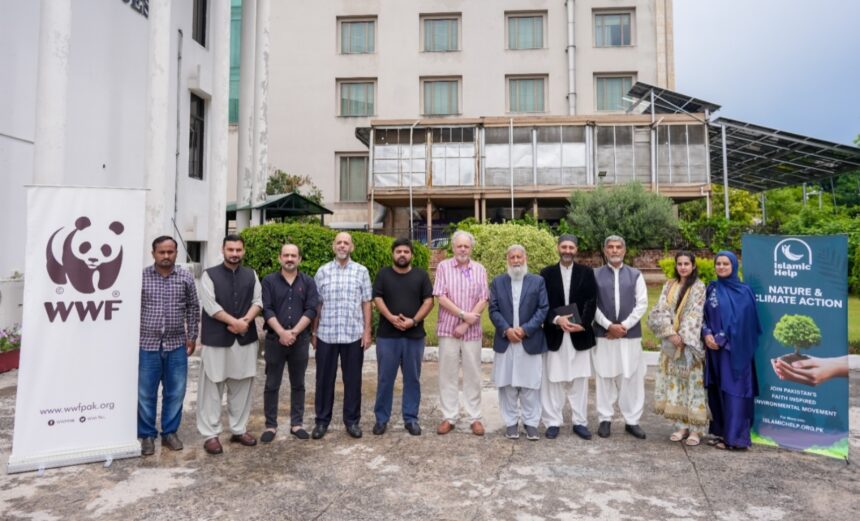
A Memorandum of Understanding signed at the WWF office in Islamabad has formalised a new partnership between Islamic Help UK and WWF-Pakistan to implement the Al Mizan Forest programme, a values-driven environmental initiative inspired by the Qur’anic principle of balance and the UNEP-supported declaration “Al-Mizan – A Covenant for the Earth”. The collaboration aims to marry faith-informed stewardship with scientific conservation to advance ecosystem restoration and climate resilience across Pakistan.
The Al Mizan Forest forms part of the global Trillion Trees effort and is designed to go beyond simple tree planting by focusing on holistic ecosystem restoration, sustainable livelihoods and long-term protection of natural areas. Programme planners say the emphasis on the Al Mizan Forest will include measures to conserve biodiversity, restore degraded land and establish nature-based solutions that benefit local communities.
Under a three-year agreement from 2026 to 2029, WWF-Pakistan will act as lead implementation partner, supplying technical expertise, planning and on-the-ground execution, while Islamic Help UK will mobilise international resources and fundraising to support rollout and expansion. Islamic Help will also work with WWF to deliver values-driven education and awareness initiatives aimed at strengthening local stewardship and eco-spiritual engagement.
Initial implementation will focus on Gilgit-Baltistan, Khyber-Pakhtunkhwa and Punjab with a projected plantation target of more than 2.7 million trees across roughly 1,700 hectares. The programme framework highlights the role of communities, youth, volunteers, educators and local leaders in sustaining restoration efforts and building climate resilience at the grassroots level.
The Al Mizan Forest will incorporate a range of integrated measures including the creation of a Green or environmental waqf to secure land for conservation, conservation zoning informed by traditional ḥima and ḥarīm practices, and agroforestry systems that support local livelihoods. Plans also prioritise wildlife corridors to improve habitat connectivity, water conservation and recharge systems, and comprehensive education and awareness activities to promote nature stewardship.
Speakers at the signing underscored the complementary strengths of the partners. Kamran Shezad of Islamic Help UK described the initiative as reconnecting environmental responsibility with values of balance and collective action, while Rab Nawaz of WWF-Pakistan highlighted the potential to expand science-based conservation through enhanced community participation. Shaykh Sultan Niaz ul Hassan reaffirmed the organisation’s commitment to turning faith-inspired principles into practical climate action, and Maulana Attaullah Shahab noted the urgency of addressing melting glaciers and changing water flows in Gilgit-Baltistan.
The MoU ceremony brought together civil society representatives, environmental organisations and development stakeholders to endorse a collaborative model that aligns scientific expertise, community ownership and institutional partnerships. Organisers say the Al Mizan Forest will serve as a replicable, values-informed approach to large-scale restoration and climate adaptation in Pakistan and beyond.