



By Nadeem Tanoli
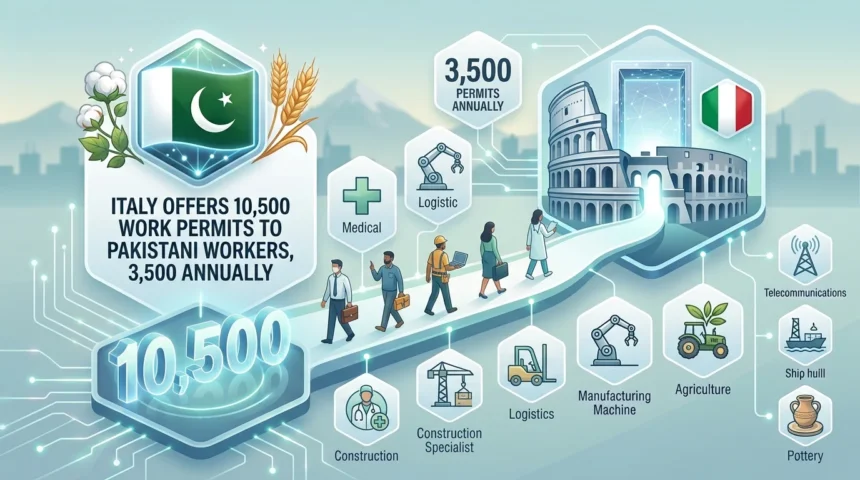
ISLAMABAD: Italy has allocated up to 10,500 work permits for Pakistani workers until 2028 under a labour mobility arrangement, opening legal employment opportunities in Europe as Pakistan moves to put in place safeguards against fraud, favouritism and exploitation.
Minister for Overseas Pakistanis and Human Resource Development Chaudhary Salik Hussain informed the National Assembly that Pakistan and Italy had signed a Memorandum of Understanding on Migration and Labour Mobility to promote the safe, legal and regulated movement of workers.
Under Italy’s Decreto Flussi programme, around 10,500 work permits have been allocated for Pakistani workers up to 2028. The expected annual share is about 3,500 workers, though the final number for each year will depend on quota notifications issued by the Italian government.
The employment opportunities are not restricted to a single sector. According to the government, jobs may be available in agriculture, construction, manufacturing, transport, hospitality, logistics, mechanics, telecommunications, shipbuilding, food processing, fishing, crafts and healthcare-related services.
The minister said the programme was employer-driven. Italian employers select workers and submit applications electronically to Italian authorities during designated application windows known as Click Days. Pakistani authorities do not decide who receives an Italian work permit.
Pakistan is developing a broader mechanism to ensure that genuine skilled workers are able to benefit from the opportunity. The ministry said a high-level Inter-Institutional Committee had been constituted, comprising officials from the ministry, the Overseas Employment Corporation, the Bureau of Emigration and Overseas Employment and the Community Welfare Attaché in Italy.
The committee will oversee the programme, monitor progress and improve coordination between Pakistani and Italian institutions.
The government also plans to engage directly with Italian employers and business groups through government-to-government and business-to-business channels to create greater demand for Pakistani workers. Licensed overseas employment promoters will also be allowed to establish direct links with Italian employers.
Officials said foreign job demands would be verified under Pakistan’s existing emigration rules before workers are sent abroad. Digital registration, online processing and public awareness campaigns are also being strengthened to reduce delays and confusion for applicants.
The Pakistan-Italy Joint Working Group will remain the main platform for addressing problems and improving cooperation under the labour agreement.
A key part of the plan is to prevent workers from being deceived. Officials said only licensed Overseas Employment Promoters and approved public-sector channels would be allowed to participate in recruitment.
Foreign job demands and employment contracts will be checked before applications move forward. Workers will also be required to complete the mandatory Protector registration and emigration clearance process.
The government said workers would be briefed about their approved job contracts, wages, accommodation and other employment conditions before leaving Pakistan.
Complaint mechanisms are available through the Bureau of Emigration and Overseas Employment, Protectorates of Emigrants and Pakistan’s Mission in Italy. These channels are intended to provide workers with a formal avenue to report problems and seek assistance.
The ministry further said action would be taken against illegal agents and fraudulent recruitment practices. Records of employers and workers will be maintained, while recruitment activities will be monitored.
To increase the number of genuine skilled workers eligible for jobs in Italy, Pakistan is also working on a verified database of skilled workers. The database will involve the Overseas Employment Corporation, the Bureau of Emigration and Overseas Employment, NAVTTC, TEVTAs and other technical training institutions.
The government said training and certification would be aligned with the requirements of the Italian labour market. Language preparation will also be encouraged so that workers are better able to understand their jobs and working conditions.
Digital systems are being strengthened to track applications, work permits, visas, emigration clearances and worker departures. Regular meetings will be held to review progress and resolve issues.
The ministry said progress reports covering job placements, employer engagement and implementation would continue to be submitted to the relevant authorities, including the National Assembly.
The government also plans awareness campaigns to warn people against illegal migration and unauthorised recruitment.
The question and the minister’s reply were laid before the National Assembly during its 29th session.