



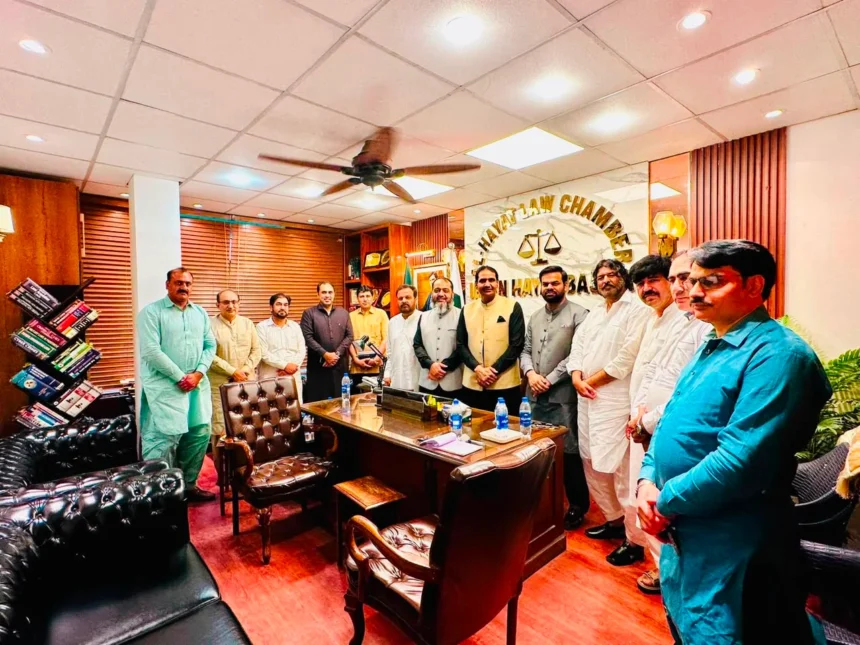
LAHORE, Aug 1, 2026: The Lahore Bar Association has called upon the Punjab government, the Governor Punjab and the Chancellor of the Punjab University to constitute an impartial inquiry committee to look into the alleged administrative, financial, academic and research-related issues facing the university.
The demand was made after a delegation of the Punjab University Joint Action Committee met the executive body of the Lahore Bar Association and briefed it on its concerns, demands and proposals regarding the affairs of the university.
The delegation met the Lahore Bar representatives under the leadership of Lahore Bar Association President Irfan Hayat Bajwa. The delegation included Prof Dr Sardar Asghar, Prof Dr Kamran Abid, Prof Dr Abdul Rehman Niazi, Prof Dr Amjad Qaiser, Javed Iqbal, Dr Aamid Ali Chaudhry, Basharat Mahmood Bhatti, Tanveer Awan and other members.
Lahore Bar Association Secretary General Malik Fayyaz Nisar Khokhar, Secretary Shoaib Ashraf Bhatti, Model Town Courts Vice President Asif Kanwal Khan, Cantt Courts Vice President Naeem Mustafa Mirza, Joint Secretary Muhammad Zubair Khan, Finance Secretary Nauman Ali, Library Secretary Raheel Hafeez Rana and other members of the executive body were also present.
During the meeting, the Punjab University Joint Action Committee delegation apprised the Lahore Bar Association of its reservations about the university’s financial, administrative, academic and research matters. The delegation maintained that during the last two years the institutional system and governance of the university had faced several issues.
It said that some important constitutional and administrative forums had not been holding meetings in a timely and regular manner, affecting collective consultation, transparent decision-making and institutional oversight.
The delegation said regular meetings of the Syndicate, Finance and Planning Committee, Selection Boards, Promotion Boards and other relevant forums were necessary to strengthen the institutional system. It stressed that these forums should be made functional and effective so that important university matters could be decided through collective consultation in accordance with law and rules.
Financial matters were also discussed during the meeting. The delegation emphasised the need to ensure transparency in the use of reserve funds, budget expenditures, accounts, self-supporting programmes, the financial situation and other financial decisions.
It said these matters should be examined independently, impartially and in accordance with law so that facts could be brought forward and any ambiguity removed.
The delegation also expressed concern over freedom of expression, freedom of association and the promotion of academic dialogue at the university. It also shared its concerns with the Lahore Bar Association regarding issues being faced by teachers, students and employees, as well as certain proceedings.
Representatives of the Punjab University Joint Action Committee said the foundation of a strong and developed university rested on an independent academic environment, transparent governance, collective consultation and institutional autonomy.
They said that to improve the academic and research standards of the university, all relevant stakeholders should be included in the consultation process and institutional decisions should be made on the basis of merit and transparency.
On the occasion, Lahore Bar Association President Irfan Hayat Bajwa and other participants heard the delegation’s point of view in detail. They said Punjab University was a historic and national academic institution of Pakistan and that maintaining its dignity, autonomy and strong institutional system was a collective responsibility of all relevant quarters.
They said the rule of law, transparency, merit, accountability and constitutional principles were basic requirements for every public and educational institution and must be upheld in all circumstances.
They added that the solution to the problems of an important national institution like Punjab University lay not in confrontation but in institutional consultation in accordance with law, respect for difference of opinion, transparent accountability and merit-based decisions.
The Lahore Bar president demanded that the Punjab government, the Governor Punjab and the Chancellor of Punjab University form an impartial inquiry committee to address the administrative, financial, academic and research-related issues facing the university.
He also proposed that a transparent and independent forensic audit of the university be conducted so that financial decisions of the previous period, use of reserve funds, accounts, budget deficit, self-supporting programmes and other financial matters could be comprehensively reviewed.
He said the purpose of the inquiry process should not be to target any individual or institution, but to bring facts to light, determine responsibility and further strengthen the university’s institutional system.
According to him, transparent investigations and effective reforms could improve the academic environment, administrative system and public confidence in Punjab University.
The Lahore Bar Association also expressed its resolve to continue supporting the principles of law, transparency, merit and institutional autonomy in matters relating to Punjab University.
The association said that if appropriate progress was not made on the demands, it would decide the future course of action in consultation with the Punjab University Joint Action Committee.
The meeting also stressed that issues of a national institution like Punjab University should be resolved through mutual dialogue and within the legal and constitutional framework so that academic activities were not affected and the university continued to play its role more effectively in research, teaching and academic development.
Participants hoped that the authorities concerned would take the concerns of all parties seriously and take transparent and positive steps to promote better governance, financial transparency, academic freedom and institutional stability at Punjab University.