



ISLAMABAD, Oct 26, 2026: Federal Minister for Climate Change and Environmental Coordination Senator Dr Musadik Malik on Monday called for stronger international cooperation on glacier research, climate innovation and equitable climate financing ahead of COP31.
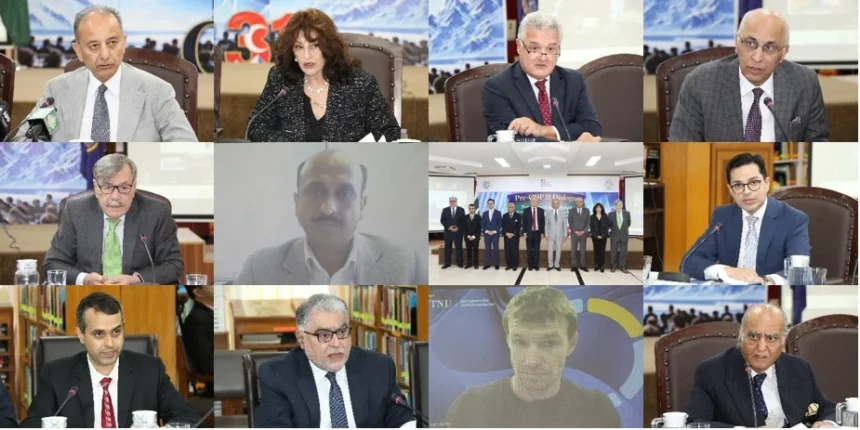
He was speaking at the Pre-COP31 Dialogue titled “From Paris to Antalya: Building Bridges Between the Arctic and the Hindu Kush-Karakoram-Himalaya Region,” held at the Institute of Strategic Studies Islamabad (ISSI).
The dialogue focused on glacier protection, climate finance and scientific cooperation between the Arctic and the Hindu Kush-Karakoram-Himalaya region.
Dr Malik highlighted the devastating impact of glacial retreat on vulnerable communities and said climate financing remained disproportionately concentrated in major emitting economies. He proposed the establishment of a Green Virtual University for international scientific collaboration, dedicated financing for green technology start-ups and a Green Cloud to provide access to publicly funded research.
The minister urged countries to move beyond declarations and work towards practical cooperation.
In his welcome remarks, ISSI Director General Ambassador Moin ul Haque highlighted the implications of glacier loss for Pakistan’s water, food and energy security. He called for stronger cooperation between Arctic and HKH institutions and greater international recognition of cryosphere-related risks.
Aisha Khan, Chief Executive of CSCCC, advocated a stronger international framework for cryosphere protection. Jean-Charles Allard, Deputy Head of Mission at the Embassy of France, reaffirmed France’s commitment to climate cooperation and scientific research.
Berk Ece, Deputy Head of Mission at the Embassy of Türkiye, highlighted COP31’s focus on implementation, climate finance and clean energy transition. Umer Siddique, Director General (UN) at the Ministry of Foreign Affairs, emphasised accessible adaptation finance, loss and damage support and transboundary data sharing.
During the panel discussion, Ambassador Shafqat Kakakhel, Chair, Board of Directors CSCCC; Purushottam Dhungel, Deputy Head of Mission at the Embassy of Nepal; Amir Khan Goraya, CEO NDRMF; Dr Faisal Mueen Qamer of ICIMOD; and Dr Pascal Emmanuel Egli of the Norwegian University of Science and Technology discussed regional cooperation, glacier monitoring, early warning systems, disaster preparedness and community resilience.
In his concluding remarks, ISSI Board of Governors Chairman Ambassador Khalid Mahmood emphasised integrating climate resilience into national development planning, strengthening domestic institutions and translating scientific research into practical policies.
The dialogue was jointly organised by ISSI, CSCCC and the Embassy of France. It brought together diplomats, policymakers, researchers and climate experts for an interactive discussion ahead of COP31.