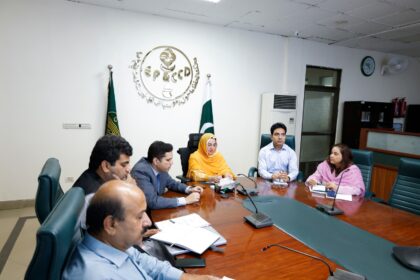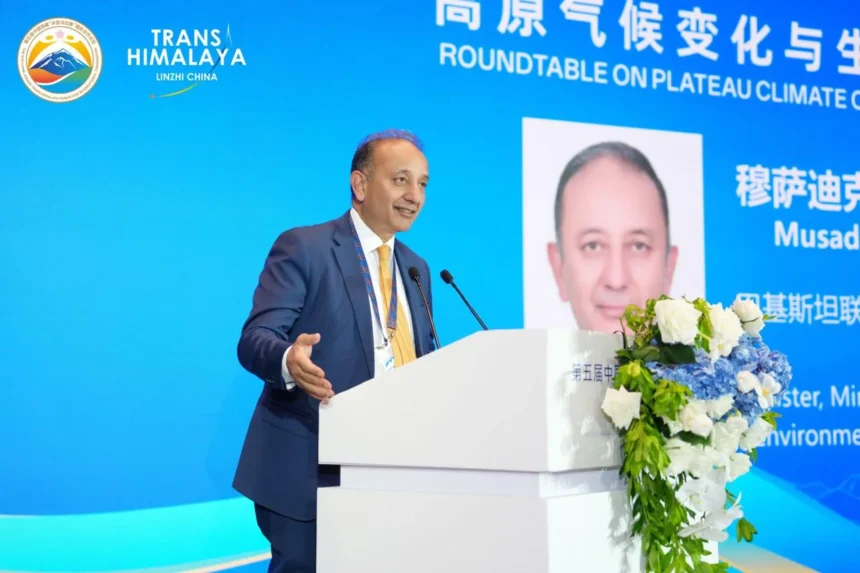
XIZANG, China, July 19, 2026: Federal Minister for Climate Change and Environmental Coordination Dr Musadik Malik addressed the 5th China Xizang Trans-Himalaya Forum for International Cooperation during his visit to the Xizang Autonomous Region of China, urging regional cooperation to protect fragile mountain ecosystems and address the growing impacts of climate change.
The forum brought together policymakers, experts and stakeholders from across the region to discuss cooperation on sustainable development, ecological conservation and shared challenges facing mountain ecosystems.
Addressing the gathering, Dr Malik said the forum was not only a celebration of the region’s shared cultural heritage, diversity, friendship, tourism and civilizations, but also a reaffirmation of the common responsibility to protect humanity and nature.
He thanked the Government of China for hosting the forum and acknowledged the longstanding friendship between Pakistan and China. He described China as a trusted partner that had consistently stood by Pakistan in both prosperous and challenging times.
The minister highlighted the deep geographical and ecological linkages between Pakistan and China through the Himalayan and Trans-Himalayan mountain systems. He said Pakistan is home to approximately 13,500 glaciers, making it one of the countries most vulnerable to the impacts of glacial melt and climate change.
Dr Malik warned that rising greenhouse gas emissions and increasing global temperatures were accelerating glacier melt, causing devastating floods followed by prolonged droughts. He said that over the past 15 years, approximately 6,000 people had lost their lives in flood-related disasters in Pakistan, while nearly 20,000 had been injured or disabled.
He further noted that around 40 million people had been displaced, resulting in an estimated 1.8 billion lost school days, reflecting the severe human and economic consequences of climate change.
The federal minister said glaciers were not merely environmental assets but the foundation of civilizations and regional prosperity. He stressed that protecting these fragile ecosystems required collective action, scientific cooperation and responsible stewardship rather than competition over natural resources.
Referring to his visit to villages in the Xizang Autonomous Region, Dr Malik appreciated China’s approach to integrating environmental conservation with economic development. He said the region presented an important model where development, prosperity and ecological protection complemented rather than contradicted each other, offering valuable lessons for other mountainous regions.
Calling for greater regional cooperation, the minister said that while individual countries were conducting research on glaciers and climate change, there remained a significant gap in coordinated transboundary scientific collaboration. He said countries sharing the Himalayan ecosystem must jointly generate knowledge and solutions to address common environmental challenges.
To strengthen regional cooperation, Dr Malik proposed three collaborative initiatives. The first was the establishment of a Virtual Green University, bringing together universities, researchers, scholars and students from across the region to undertake joint research on glaciers, climate change, ecology, economics and sustainable development.
He said such a platform could also generate knowledge useful for addressing future challenges in other fragile ecosystems, including the Arctic.
The second proposal, titled Green Fields, seeks to create a regional platform connecting young entrepreneurs with financial support and investment opportunities to develop innovative climate solutions in renewable energy, battery technologies, climate-resilient infrastructure, safe drinking water and other green technologies.
The minister also proposed the creation of a Green Cloud, an open platform through which publicly funded scientific research and intellectual property generated by universities could be made freely accessible to innovators, researchers and entrepreneurs.
Concluding his address, Dr Malik called upon all participating countries to work collectively to protect glaciers, preserve shared ecosystems and safeguard future generations. He said climate action required shared responsibility, scientific cooperation and a common commitment to ensuring that development and environmental protection moved forward together.