



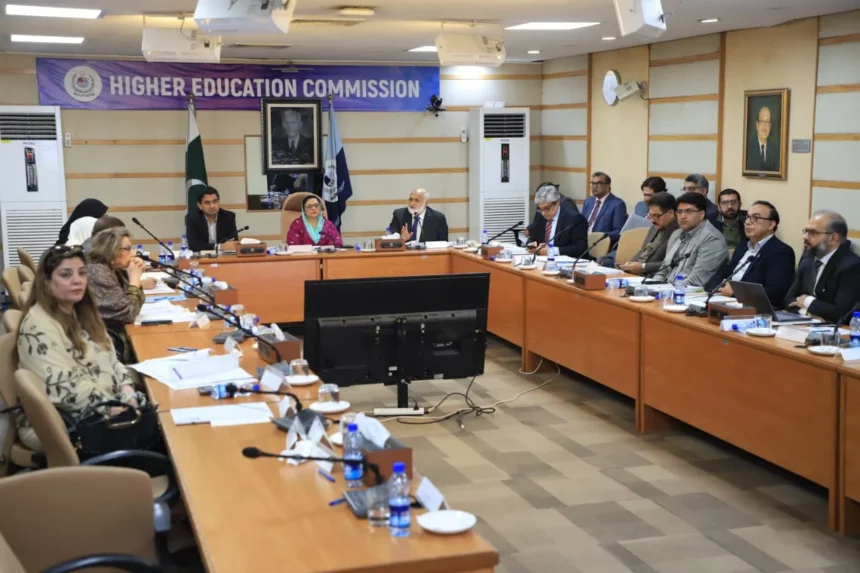
ISLAMABAD: The National Assembly Standing Committee on Federal Education and Professional Training has expressed serious concern over the challenges faced by children with dyslexia and stressed that their educational future and prospects must not be compromised due to the absence of proper identification, institutional support and remedial interventions.
The 27th meeting of the committee was held at the Committee Room of the Higher Education Commission, Islamabad, under the acting chairmanship of Dr Shazia Sobia Aslam Soomro, MNA.
The committee observed that after the enactment of the Dyslexia Act, its effective implementation had become imperative. It called for addressing the issues confronting children with dyslexia in both public and private educational institutions.
It stressed the need for appropriate academic facilitation for such children across various subjects, particularly Mathematics, in accordance with their individual learning needs.
The committee also resolved to raise the matter on the floor of Parliament to advocate suitable relaxation and accommodations in the curriculum, assessment and examination systems. It underlined that children with dyslexia should not be disadvantaged or denied opportunities for admission to higher education on account of their learning difficulties.
The committee emphasised that the Ministry of Federal Education and Professional Training should include dedicated budgetary allocations in its regular budgetary framework and policy planning. It also called for provisions for the recruitment, capacity-building and professional training of remedial therapists, psychologists and specialised teachers to ensure a sustainable and institutionalised support mechanism for children with dyslexia.
The National Institute of Psychology, a Centre of Excellence at Quaid-i-Azam University, informed the committee that it was collaborating with the Federal Directorate of Education to develop and implement a structured remedial support system for children with dyslexia in schools across Islamabad.
The committee was apprised that the initiative would be implemented in five phases to ensure systematic identification, assessment and targeted remedial support for children with dyslexia.
The first phase will focus on mobilisation and vetting, followed by screening, assessment and profiling, which is scheduled to be completed by December 2026. The third phase, involving individualised remedial therapy, will be carried out from January 2027 to February 2028 to provide tailored interventions according to the learning needs of identified children.
The fourth phase, establishment of sustainable support systems, will be implemented from March 2028 to May 2028 to ensure continuity of remedial support within the education system. The initiative will conclude with evaluation and closeout from May 2028 to June 2028 to assess the overall progress and outcomes of the project.
The committee was also briefed on the National Dyslexia Diagnostic Tool, which is being used to identify children with dyslexia through a comprehensive assessment of developmental and learning domains. The tool comprises four components: Cognitive and Perceptual-Motor Assessment, Language and Phonological Assessment, Social-Emotional Checklist, and Child Problem Checklist.
The Higher Education Commission informed the committee that, according to the QS World University Rankings 2027, 18 Pakistani universities had secured positions in the global rankings, reflecting growing international recognition of Pakistan’s higher education sector.
Two Pakistani universities have been placed among the world’s top 500 institutions. Quaid-i-Azam University, Islamabad, has been ranked 381, while the National University of Sciences and Technology, Islamabad, has been ranked 384.
A total of 11 Pakistani universities have secured positions among the world’s top 1,000. These include Quaid-i-Azam University, NUST, Pakistan Institute of Engineering and Applied Sciences, University of the Punjab, Lahore University of Management Sciences, University of Agriculture Faisalabad, COMSATS University Islamabad, Government College University Faisalabad, University of Engineering and Technology Lahore, Aga Khan University and University of Peshawar.
The HEC informed the committee that it had constituted a Committee on International University Rankings to facilitate institutional engagement, develop a common understanding of ranking methodologies and performance indicators, identify key challenges affecting the global competitiveness of Pakistani universities, and recommend strategies to improve performance in international rankings.
The initiative is aimed at strengthening institutional capacity, promoting a culture of academic excellence, and enhancing the global visibility and competitiveness of Pakistan’s higher education institutions.
The HEC also briefed the committee about its fully online and paperless Degree Attestation System, which has replaced the previous attestation mechanism. The new system has been designed to provide a streamlined, efficient, transparent and user-friendly process for applicants.
The paperless system was described as a significant step towards the digital transformation of HEC’s public service delivery. It is expected to enhance accessibility, reduce procedural delays, improve administrative efficiency, and provide a more convenient and transparent attestation service.
The committee was apprised of key challenges confronting universities, including governance-related matters, financial constraints, issues concerning the assessment and evaluation of faculty members, and shortages of qualified human resources.
It was informed that the HEC regularly issues policy guidelines to universities on academic and administrative matters, including plagiarism prevention and undergraduate education policies, to ensure uniformity, quality assurance and compliance with established academic standards.
The HEC further clarified that the establishment of university campuses at tehsil level was not permissible under the existing policy framework. It also proposed that the Ministry of Foreign Affairs may consider deputing designated officials at HEC to facilitate closer coordination and expedite the processing of degree attestation and accreditation-related matters for applicants.
The committee recommended that the Ministry of Federal Education and Professional Training establish effective liaison and coordination with the committee constituted by the Minister for Planning, Development and Special Initiatives to explore avenues for securing the required financial resources to address issues confronting the ministry.
It stressed that coordinated efforts among relevant stakeholders were essential for timely identification of funding requirements, prioritisation of outstanding issues and allocation of adequate resources for their effective resolution.
Regarding the functioning and role of School Management Committees, as well as concerns related to the provision of buses and adequate transport facilities for students, the committee asked the ministry to furnish comprehensive details through a structured questionnaire.
The meeting was attended by MNAs Anjum Aqeel Khan, Raja Khurram Shahzad Nawaz, Zulfiqar Ali Bhatti, Zeb Jaffar, Farah Naz Akbar, Syeda Amnah Batool, Dr Shazia Sobia Aslam Soomro, Mahtab Akbar Rashdi, Mussarat Rafique Mahesar, Abdul Aleem Khan, Sabheen Ghoury and Aliya Kamran. The secretary of the Ministry of Federal Education and Professional Training, the HEC chairman, ministry officials, HEC officials and other officers concerned also attended the meeting.