



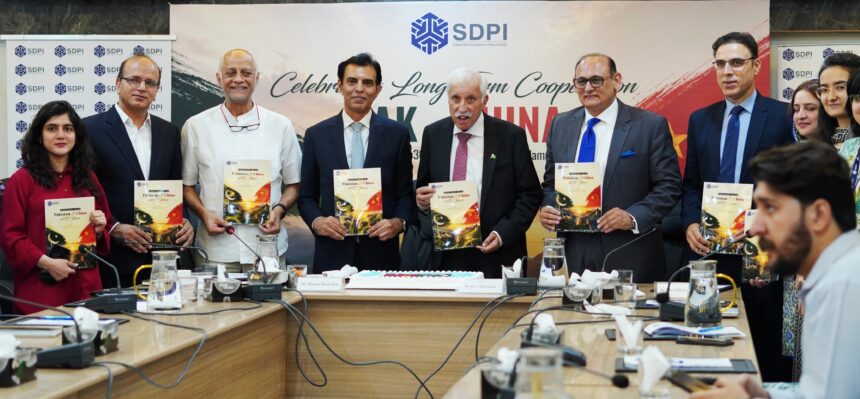
Pak China ties were described as an “unparalleled model” of bilateral cooperation as officials and experts gathered in Islamabad to mark 75 years of diplomatic relations and launch a new SDPI report tracing the shift from CPEC’s first phase to its transformative second phase. Federal Minister for Investment Qaiser Ahmed Sheikh said the two countries have weathered global upheavals despite persistent bureaucratic hurdles and regulatory complexity that continue to slow private Chinese investment.
The minister highlighted a pending amendment intended to facilitate Chinese textile investment that has been held up for six months despite the prime minister’s approval, pointing to arduous internal procedures that impede the flow of foreign direct investment. Such delays underline experts’ warnings that converting government-level goodwill into business-to-business reality requires urgent bureaucratic reform and regulatory predictability.
Shi Yuanqiang, Deputy Head of Mission at the Chinese Embassy, praised the resilience of the bilateral relationship and noted a shared resolve at the highest levels to deepen people-to-people ties. SDPI leadership echoed that message while flagging practical constraints, including IMF programme restrictions that limit some policy actions necessary to operationalize Special Economic Zones.
Dr Abid Qaiyum Suleri and Dr Sajid Amin Javed of SDPI stressed that the core challenge for Pak China ties is translating diplomatic strength into tangible business outcomes. They called for clearer tax treatment, security guarantees, and a streamlined regulatory environment so Chinese firms can engage directly with Pakistani businesses and take full advantage of preferential arrangements.
Former AIIB managing director Hamid Sharif recalled historical cooperation such as the Karakoram Highway project and noted that China accounts for roughly 53 percent of Pakistan’s FDI. He also pointed to worrying imbalances: bilateral trade has topped $45 billion while Pakistan’s exports to China remain near $2.4 billion and exporters have used only about 30 percent of available concessions. Sharif warned that SEZs have underperformed because of regulatory unpredictability and a bureaucratic maze that discourages Chinese B2B investment.
Dr Khalid Waleed presented the new report, outlining phase two priorities including green energy, industry, technology and mining, with projected investments of USD 30 to 50 billion into SEZs and the potential to create thousands of jobs. He urged Pakistan to capitalise on a growing solar revolution, the rise of EVs and initiatives tied to China GDI, GCI, GSI and GGI while implementing the 5Es of Uraan Pakistan to operationalize cooperation.
Panelists also reflected on changing global dynamics and long-term visions toward 2047 and beyond. Dr Hassan Daud Butt spoke about Chinese development models that support regional partners, and noted Pakistan’s inaugural Panda Bond was five times oversubscribed. Dr Syed Hasnat Shah underlined the rarity of such sustained alignment between two countries with different systems and cultures, reinforcing that strong Pak China ties now require policy reforms to convert diplomatic capital into inclusive economic gains.