



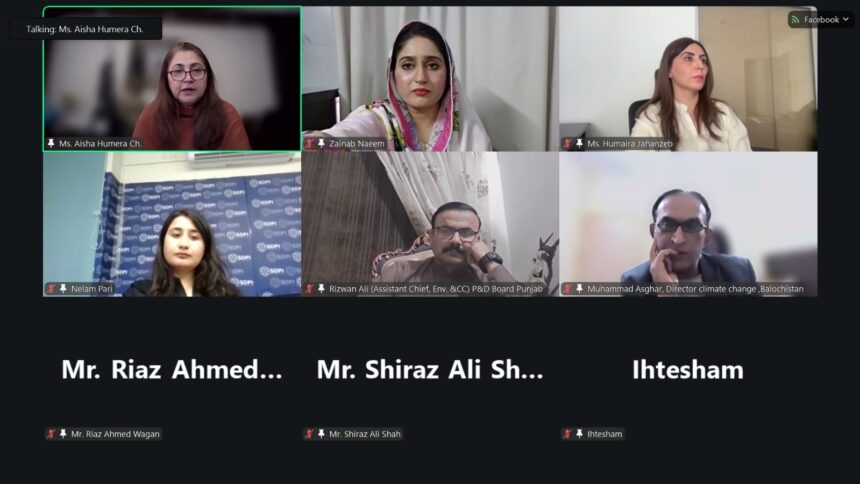
Senior officials, development experts and civil society representatives urged a stronger push to embed climate adaptation within local governance as Pakistan moves ahead with district-level planning under its National Adaptation Plan. The call came at a webinar organised by the Sustainable Development Policy Institute alongside the National Adaptation Plan team, supported by UNEP with Green Climate Fund backing and implemented by the Ministry of Climate Change and Environmental Coordination.
Aisha Humera Chaudhary, Federal Secretary at the Ministry of Climate Change and Environmental Coordination, said adaptation must produce tangible improvements for farmers, schoolchildren, pregnant women and other vulnerable groups confronting floods, heatwaves and glacial melt. She urged that local innovations be integrated into formal systems and suggested provincial challenge funds, procurement reforms to enable SMEs and tech entrepreneurs, and joint studies to identify barriers to scaling local solutions.
Dr Saad Khan, Additional Secretary at the ministry, warned that awareness of the National Adaptation Plan remains limited despite its importance, and highlighted a shortage of climate specialists and bureaucratic delays that affect project timelines. He recommended that district adaptation plans be used as pilots and cautioned against mechanically replicating them across provinces with different geographies and vulnerabilities.
Zainab Naeem of SDPI stressed that climate adaptation is a lived reality for Pakistani communities and emphasised the need for Climate Risk and Vulnerability Assessments to prioritise district-specific threats such as riverine and flash floods, droughts and heatwaves so that planning is evidence-based.
Humaira Jahanzeb, Project Lead of the GCF-NAP Project at the ministry, outlined that the NAP approved in August 2023 contains 117 adaptation measures across six vulnerable sectors including the agri-water nexus, natural capital, human capital, disaster risk reduction, gender and social inclusion and urban resilience, and has been submitted to the UNFCCC for global alignment.
Shiraz Ali Shah from UNDP Pakistan described community-level adaptation as essential given Pakistan’s varied terrain, pointing to UNDP’s flood recovery work after 2022 that prioritises resilient housing, infrastructure rehabilitation and preparedness at the local level.
Dr Ihtesham ul Haq of Khyber Pakhtunkhwa’s Planning and Development Department welcomed SDPI’s support for district planning and said updated district adaptation plans will inform policy and be integrated into upcoming Annual Development Programmes from July 2026, with earlier plans being revised using federal templates.
Rizwan Ali from Punjab’s Planning and Development Board reported climate budget tagging for the current fiscal year, noting that of Punjab’s Rs1,240 billion Annual Development Programme, Rs795 billion has been tagged for climate measures and about Rs277 billion is specifically allocated for adaptation, and he urged further downscaling of planning to tehsil and union council levels.
Riaz Ahmed, Chief Conservator of Forests in Sindh, highlighted ecosystem-based adaptation including mangrove restoration through public–private partnerships, and announced agreements to restore 100,000 acres of forest in Matiari and Jamshoro districts as mangrove cover recovers from a degraded baseline.
Mohammad Asghar of Balochistan’s Environment Department said the province has set aside Rs500 million for community-led adaptation, directing funds to district-level adaptation committees to allow local design and implementation of solutions outside conventional bureaucratic channels.
Environmental journalist Afia Salam warned of a communication gap between policy language and community realities and urged simplification of climate terminology so adaptation planning reaches union council and village levels. She pointed to grassroots practices such as glacier grafting in northern areas, Miyawaki urban forests, traditional zero-carbon architecture, bamboo floating wetlands and permaculture as examples of practical adaptation without optics.
The discussion underscored pragmatic steps to make climate adaptation operational: strengthen institutional capacity, improve access to finance, adopt gender-responsive planning and coordinate across federal, provincial and local levels so district plans deliver measurable benefits on the ground. The webinar was moderated by Neelam Pari of SDPI, who framed the need to move beyond symbolic efforts and scale proven local solutions through targeted policy and funding reforms.