



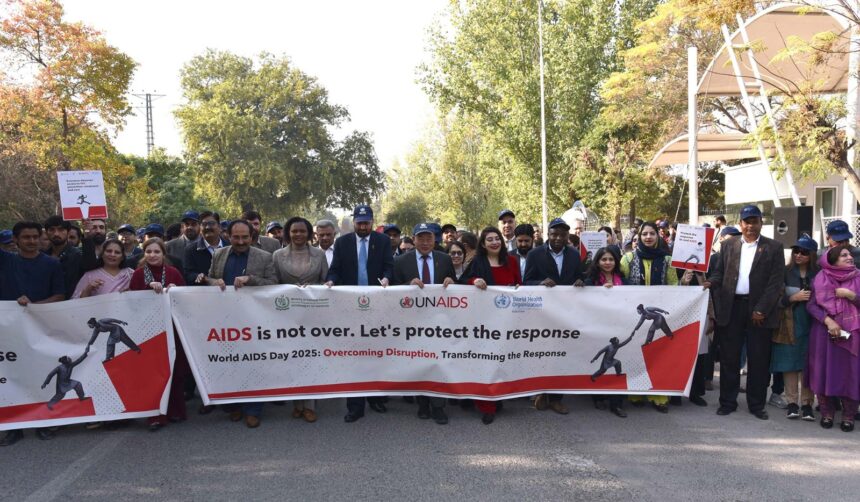
On World AIDS Day, WHO and UNAIDS joined Pakistan’s health authorities to warn that the Pakistan HIV epidemic is accelerating and requires immediate collective action. Under the theme Overcoming disruption, transforming the AIDS response, partners held an awareness walk to press for intensified prevention, testing and treatment.
New HIV infections in Pakistan have increased by 200% over the past 15 years, rising from 16,000 in 2010 to 48,000 in 2024. The country now faces one of the fastest-growing HIV epidemics in the WHO Eastern Mediterranean Region, with children and wider communities increasingly affected.
The shift in transmission patterns reflects unsafe blood management and injection practices, gaps in infection prevention and control, limited HIV testing during antenatal care, unprotected sexual activity, pervasive stigma and constrained access to HIV services. Recent outbreaks in Shaheed Benazirabad, Hyderabad, Naushahro Feroze, Pathan Colony (2025), Taunsa (2024), Mirpur Khas (2024), Jacobabad and Shikarpur (2023), and Larkana (2019) have disproportionately affected children, with several outbreaks reporting more than 80% of detected cases among minors.
Dr Ayesha Majeed Isani, Pakistan’s Health Director General, urged community engagement and regulatory action, saying that discrimination and unsafe practices cannot be tackled by health authorities alone and that clinicians, communities and regulators all must work together to protect children and adults from HIV. The WHO Representative in Pakistan, Dr Luo Dapeng, reaffirmed WHO’s commitment to support Pakistan in safeguarding future generations, while the UNAIDS Director in Pakistan, Trouble Chikoko, called for urgent shifts in programming and renewed international financing to expand prevention, testing, treatment and care for key populations, women and children.
About 350,000 people are estimated to be living with HIV in Pakistan, yet nearly eight in 10 do not know their status. New paediatric cases rose from 530 in 2010 to 1,800 in 2023. Over the last decade Pakistan has scaled up antiretroviral therapy (ART) access: people on ART increased from roughly 6,500 in 2013 to 55,500 in 2024, and the number of ART centres grew from 13 in 2010 to 95 in 2025. Despite this progress, in 2024 only an estimated 21% of people living with HIV knew their status, 16% were on treatment and just 7% had achieved viral load suppression. More than 1,100 AIDS-related deaths were reported that year.
Prevention of mother-to-child transmission remains a critical gap: only 14% of pregnant women who need treatment receive it, exposing thousands of infants to risk, and among children aged 0–14 living with HIV only 38% are on treatment. Tackling these shortfalls will require safer blood and injection practices, routine antenatal testing, expanded community outreach and rigorous infection prevention measures across healthcare settings.
WHO and UNAIDS, in partnership with Pakistan’s Ministry of Health and other stakeholders, are calling for unified national and international efforts to reverse the Pakistan HIV trend, close financing gaps and scale up services so that the goal of ending AIDS as a public health threat by 2030 remains within reach.