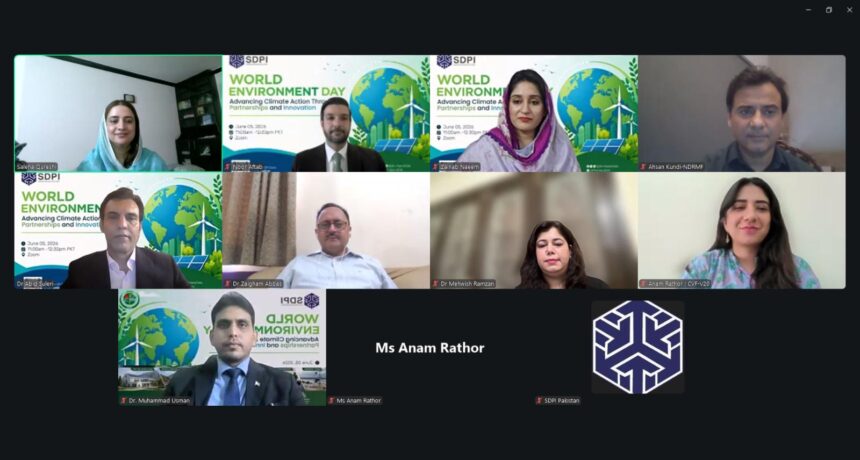
On World Environment Day experts urged Pakistan to make climate action a central pillar of development planning and budgeting, calling for evidence based policymaking, innovative finance and stronger institutional partnerships to manage escalating climate risks.
Dr Abid Qaiyum Suleri, Executive Director of the Sustainable Development Policy Institute and chair of the National Disaster Risk Management Fund board, said climate resilience must be aligned with national policies, budget priorities and local implementation. He described climate adaptation as an economic investment that protects livelihoods, infrastructure and future growth and stressed scaling up climate finance while keeping vulnerable communities at the centre of interventions.
Syed Abrar Hussein, Director General of the Pakistan Environmental Protection Agency, highlighted practical community level outcomes, including the conversion of confiscated single use plastics into benches and planters and the retrofit of 33 brick kilns in Islamabad with zigzag technology to cut emissions. He noted cooperation with the steel industry on bag filter systems that capture emissions and recover zinc, and urged awareness, training and promotion of climate smart agriculture for farmers.
Dr Shafqat Munir of SDPI warned that climate change is a present development reality affecting food and water security, public health and social cohesion. He urged a move beyond fragmented projects toward partnerships that align science, policy, finance and community action so that climate action becomes a practical development pathway for Pakistan.
Dr Muhammad Usman from the National Disaster Management Authority said recent disasters underline the need for anticipatory action, impact based forecasting and multi channel early warning dissemination. He described steps to strengthen the National Emergency Operations Centre and recommended integrating climate resilience standards into infrastructure planning with a multi hazard approach covering floods, heatwaves, glacial hazards and landslides.
Sohail Maqbool Malik of the Climate Resourcing Coordination Centre urged converting national commitments into a pipeline of bankable, investment ready projects to bridge large climate finance gaps. Anam Rathore of the Climate Vulnerable Forum and V20 Finance Ministers called for easier access to international adaptation and loss and damage finance for vulnerable countries like Pakistan.
Ahsan Kundi of the National Disaster Risk Management Fund underlined the role of public private partnerships in disaster risk financing and the Fund’s work on a Disaster Risk Financing Strategy Framework to ensure resources are prepositioned for recovery and reconstruction. Noor Aftab from Tetra Pak urged a circular economy approach, design for recyclability and a standardized national Extended Producer Responsibility framework aligned with global best practices.
Dr Mehwish Ramzan of Jazz stressed the private sector’s growing role through ESG and green innovation to accelerate a transition to a low carbon, resilient economy. The webinar, moderated by Saleha Qureshi of SDPI, brought together policymakers, researchers, development partners and industry to discuss how partnership and innovation can advance climate action across Pakistan.