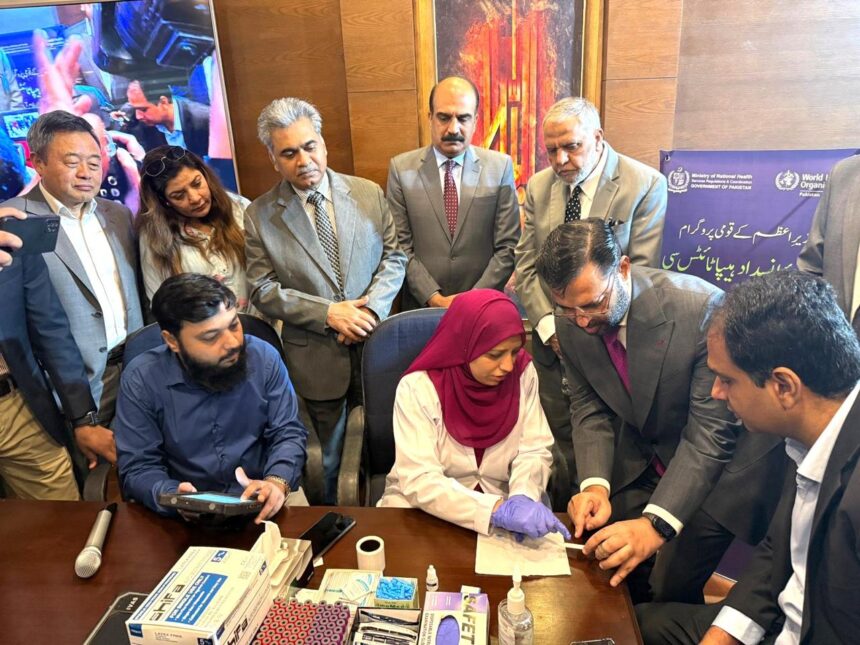
Pakistan and the World Health Organization have launched the Prime Minister’s National Programme for the Elimination of Hepatitis C in the Islamabad Capital Territory, aiming to reach 1.6 million people in the next six months. The initiative will be rolled out in subsequent phases across the country to test more than 164 million people and provide life-saving treatment with the goal of eliminating Hepatitis C as a public health threat by 2030.
Pakistan carries a disproportionate share of the global burden, with an estimated 10 million of the nearly 50 million cases worldwide. An estimated 110,000 new infections occur in Pakistan each year, with about 62% linked to unsafe medical injections and blood transfusions and 38% related to injection drug use. Globally, only around one in three people living with Hepatitis C know their status, highlighting the need for large-scale testing and outreach.
Under the leadership of the Ministry of National Health Services, Regulations and Coordination and with technical support from WHO, the programme will focus on prevention, early detection and prompt treatment. Pilot phases in select provinces have helped shape operational planning, revealing practical lessons for a national scale-up and confirming the feasibility of mass testing and treatment in the Pakistani context.
Federal Health Minister Syed Mustafa Kamal emphasised that eliminating Hepatitis C is a national priority and a matter of public security and economic welfare, calling for strict adherence to blood and injection safety measures. WHO Representative Dr Luo Dapeng reiterated WHO commitment to support Pakistan with evidence-based practices and to prioritise prevention measures such as preventing mother-to-child transmission, safe injections and blood transfusions, and harm reduction programs.
The programme is expected to generate significant economic benefits. Over the next five years it could save about 3.3 billion Pakistani rupees in combined treatment and hospitalisation costs, and by 2030 the national return on investment is estimated at approximately US$8 for every US$1 invested. Long-term modelling suggests the initiative could avert an estimated 850,000 deaths and prevent around 1.1 million new infections by 2050 if implemented at scale.
Implementation will begin across Islamabad Capital Territory before expanding nationwide, with testing, treatment and strengthened prevention measures at the centre of efforts to reduce transmission and improve health outcomes for people living with Hepatitis C in Pakistan.