




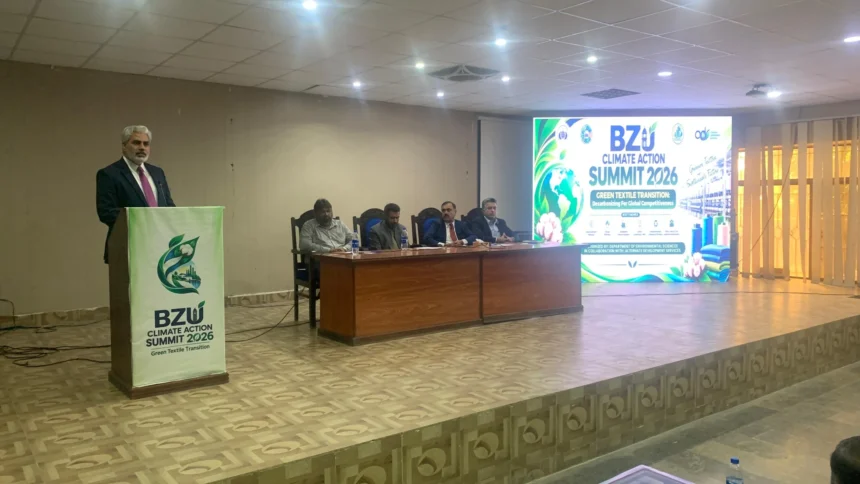
MULTAN: Pakistan’s textile and apparel exporters must accelerate their shift towards cleaner production, energy efficiency and internationally recognised sustainability standards to remain competitive in global markets, industry leaders and environmental experts said at the second two-day BZU Climate Action Summit 2026.
The summit was organised by the Department of Environmental Sciences, Bahauddin Zakariya University (BZU), in collaboration with Alternate Development Services (ADS). Speakers highlighted increasing international requirements for verified emissions data, supply-chain traceability and environmental, social and governance (ESG) compliance.
They noted that exports to the European Union, Pakistan’s largest textile market, stood at around $7.1 billion out of total textile exports of $17.9 billion in FY2025-26. They said sustainability standards were becoming increasingly important for maintaining market access, particularly under the GSP+ arrangement.
Khawaja Muhammad Qasim, Central Chairman of APBUMA, said a clean environment was essential for both industry and communities. He urged industrialists to take responsibility for reducing emissions instead of waiting for government intervention. He identified solar power, battery storage and wind energy as important alternatives and particularly highlighted Balochistan’s potential for wind power.
Prof Dr Javed Ahmed, Dean, Faculty of Science, BZU, stressed the need for stronger academia-industry linkages to address environmental challenges. He said universities could support businesses through research, data collection, software development and technical expertise, while internships could prepare students for emerging sustainability-related professions.
ADS Chief Executive Officer Amjad Nazeer said carbon emissions were increasingly influencing international trade and competitiveness. He warned that Pakistani exporters risked losing orders if they failed to meet sustainability requirements and provide reliable environmental data.
Referring to the SECP’s ESG Disclosure Guidelines and Pakistan Green Taxonomy, he said green production and sustainability reporting, including through Global Reporting Initiative standards, required effective implementation. He observed that most Pakistani textile companies were still at an early stage of carbon disclosure, GRI reporting and greenhouse gas accounting, making accelerated capacity-building essential.
Mr Nazeer said ESG compliance was crucial for maintaining Pakistan’s preferential access to the EU under GSP+, which is due for renewal under the upcoming review. He said compliance could help exporters strengthen their position in the EU market, where Pakistani textile exports had remained around $7 billion to $8 billion for an extended period. He also highlighted the roles of the Science Based Targets initiative and measurement, reporting and verification systems, adding that carbon accounting was creating new career opportunities.
During a policy dialogue moderated by Dr Muhammad Dawood, industry representatives discussed the financial, technical and regulatory challenges of the green transition. Dr Zafar Iqbal of the Environmental Protection Agency said decarbonisation was necessary for industrial competitiveness and environmental protection.
Hammad Haseeb Rao of Zephyrs Textile said sustainability compliance must extend across the entire value chain, from cotton cultivation to finished products. He identified reliable supply-chain data, verification and traceability as major challenges and stressed the need for digital product passports and a centralised software system for carbon accounting.
Basharat Hashmi of Fazal Cloth Mills called for a clear government roadmap and financial support, saying shrinking profit margins and inadequate solar energy policies were making the transition difficult. Shakeel Ahmad of Reliance Weaving Mills highlighted the cost of wastewater treatment and called for effective regulation of all polluting industries, a national consensus on environmental compliance and practical university research.
Participants also stressed the need to help small and medium-sized enterprises overcome shortages of technical expertise and financial resources. They called for a national compliance framework and stronger academic support to obtain verifiable data.
In the technical session, Muhammad Yameen Qureshi of Huawei Pakistan discussed solar energy and battery storage as phased solutions for industrial energy transition. Hameed Akhtar of the EPA highlighted the environmental costs of fast fashion, recycling and responsible resource use, while Muhammad Usman bin Ahmed of ADS explained the importance of MRV in ESG compliance and the potential of the Competitive Trading Bilateral Contract Market to provide industrial consumers access to cleaner electricity.
The summit’s second day focused on practical capacity-building, with industry representatives, professionals and students receiving hands-on training in greenhouse gas accounting, industrial energy auditing, MRV and decarbonisation planning.