




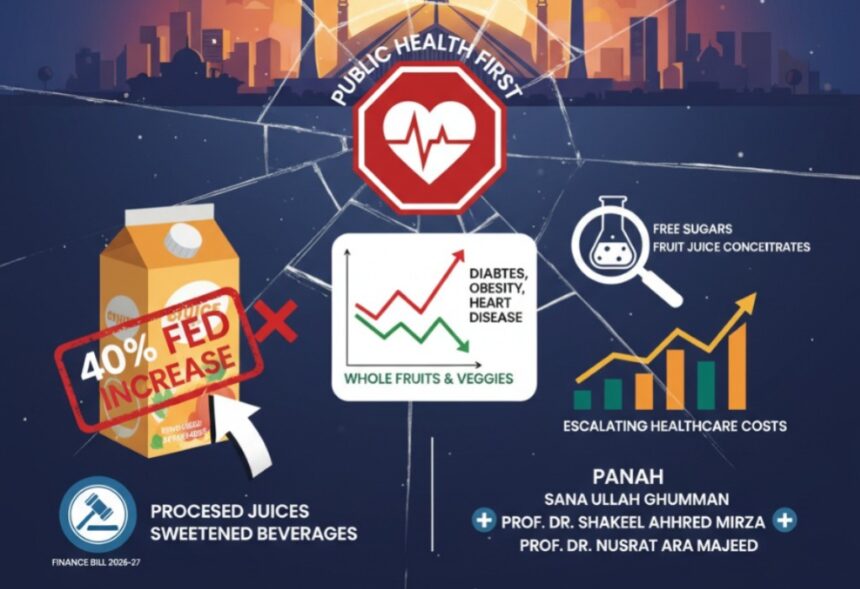
The Pakistan National Heart Association (PANAH) has warned that rising consumption of processed juices is worsening the country’s public health crisis and urged policymakers to resist industry pressure for tax relief. Sana Ullah Ghumman told reporters that some elements within the juice sector are attempting to present juices as healthy products to secure exemptions, a move he said would mislead legislators and the public.
Ghumman highlighted that Pakistan faces sharply increasing rates of diabetes, obesity, heart disease, hypertension and fatty liver disease, creating a heavy financial burden on families and the national healthcare system. He argued that weakening health taxes now would be counterproductive and called for the Federal Excise Duty on all sweetened beverages, including fruit juices, to be increased to 40 percent in the Finance Bill 2026–27 as part of a robust juice tax policy.
Renowned diabetologist Prof. Dr. Shakeel Ahmed Mirza pointed to World Health Organization guidance noting that “free sugars” include sugars naturally present in honey, syrups, fruit juices and fruit juice concentrates. He said the WHO recommends limiting free sugar intake to below 10 percent of daily energy, and preferably under 5 percent for sugars consumed in liquid form, meaning fruit juices are a key source to restrict when designing public health measures like a juice tax.
Prof. Dr. Nusrat Ara Majeed, Commissioner Asia Pacific Region for Prevention of Cardiovascular Diseases, warned that any tax relief on packaged juices risks sending the false message that these products are endorsed by the government and safe for frequent consumption. She urged promotion of whole fruits and vegetables over fruit juices to align consumer behaviour with public health guidance.
PANAH noted that health taxes on sweetened beverages, including juices, are globally recognised as effective tools to deter unhealthy consumption while generating revenue to support health services. The association stressed that the long-term economic cost of non-communicable diseases far outweighs any short-term commercial gains claimed by the processed beverage sector.
Health experts, PANAH and allied civil society organisations urged the government to reject industry demands for concessions and to strengthen the juice tax framework in the upcoming Finance Bill 2026–27. They called on policymakers to prioritise public health over corporate interests and to adopt a clear policy that reduces consumption of ultra-processed beverages to protect Pakistan’s future health and fiscal stability.