



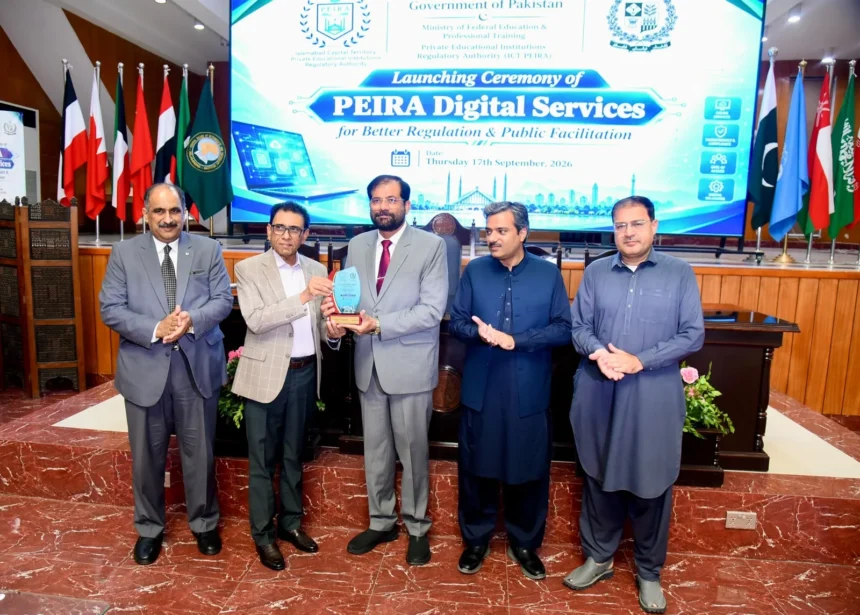
ISLAMABAD: The Private Educational Institutions Regulatory Authority (ICT-PEIRA) has launched its “PEIRA Digital Services” initiative, describing it as a major step towards paperless regulation, improved transparency, institutional efficiency and better public facilitation in Islamabad’s private education sector.
The launching ceremony was held at the auditorium of the Federal Board of Intermediate and Secondary Education (FBISE), Islamabad, on September 17, 2026. Federal Minister for Education and Professional Training Dr Khalid Maqbool Siddiqui attended the event as chief guest.
Senior government officers, educationists, representatives of private educational institutions and other distinguished guests from across Islamabad were also present on the occasion.
Addressing the ceremony, Dr Siddiqui appreciated ICT-PEIRA for introducing comprehensive digital services and commended the authority for using technology to make regulatory processes more transparent, accessible and citizen-friendly.
The minister said transparency was a fundamental pillar of good governance and democracy, adding that technology provided an effective means to promote transparency, accountability and public confidence in institutions.
Highlighting the importance of digital transformation, he said facilities such as online registration and renewal, e-licensing, complaint redressal, attestation and migration services were necessities of a modern regulatory system rather than optional services.
He observed that citizens and educational institutions should be able to access essential regulatory services conveniently without unnecessary paperwork, delays and repeated visits to government offices.
Speaking on the occasion, ICT-PEIRA Chairman Dr Ghulam Ali Mallah thanked the Ministry of Federal Education and Professional Training for its continued support, guidance and encouragement in advancing PEIRA’s reform and digital transformation agenda.
Dr Mallah said the role of a modern regulator should not be confined to enforcement alone. “Regulators must also be facilitators. Our responsibility is to facilitate educational institutions while ensuring quality education, institutional accountability and implementation of government policies,” he stated.
He highlighted the critical contribution of the private education sector to the federal capital, noting that private educational institutions account for around 60 percent of the total student enrolment in ICT.
Given this significant share, he said constructive engagement with private institutions, coupled with effective regulation and quality assurance, was essential for strengthening Islamabad’s education system.
Dr Mallah further said digital transformation was not merely a technological upgrade but an institutional reform aimed at making regulatory services faster, simpler, more transparent and accessible.
He said the initiative sought to reduce paperwork, minimise unnecessary physical visits and provide stakeholders with a more responsive regulatory environment.
According to ICT-PEIRA, the launch of PEIRA Digital Services reflects the authority’s broader commitment to digital governance, transparency, ease of doing business, quality assurance and citizen-centric public service delivery.
The initiative also supports the government’s vision of using technology to modernise public institutions and make government services more accessible to citizens.
The ceremony concluded with closing remarks and a vote of thanks by Member Academics ICT-PEIRA Imtiaz Ali Qureshi, who acknowledged the support and guidance of the federal minister, the leadership of the ICT-PEIRA chairman, participating educational institutions, officials and all stakeholders who contributed to the successful launch of the initiative.