



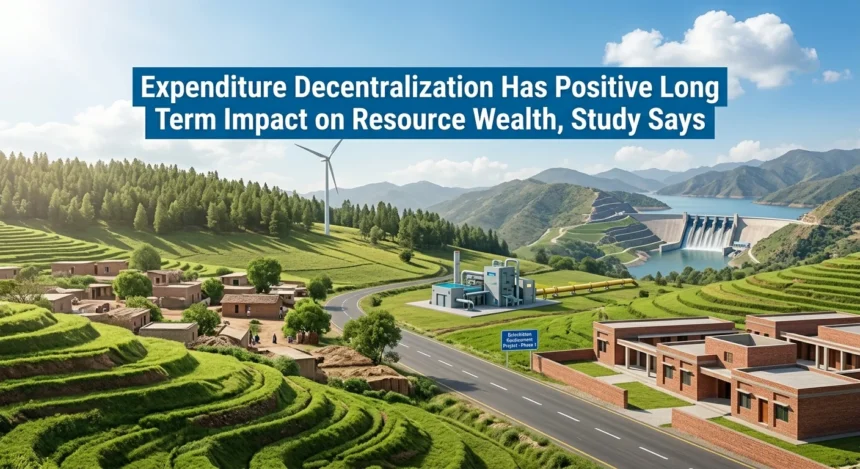
ISLAMABAD: A study on Pakistan’s natural resources has found that giving provincial and local governments greater responsibility for spending can help improve the management of natural resource wealth, while weak governance, revenue leakage and institutional shortcomings continue to restrict the country’s ability to benefit fully from oil, gas, minerals, coal and forests.
The study examined the relationship between fiscal decentralization, globalization and natural resource rents in Pakistan from 1983 to 2023. Its key finding, based on the available text, is that expenditure decentralization has a significant positive long-term relationship with natural resource rents.
According to the researchers, this suggests that provincial and local governments can contribute to better resource management when they are able to invest more effectively in infrastructure. Such investment can influence how natural resources are explored, transported, processed and brought into the formal economy.
The study focuses on a major policy question for Pakistan after the 18th Constitutional Amendment: whether giving provinces greater financial powers can help convert natural resources into sustainable development, or whether weak governance could shift the resource curse from the federal level to the provincial level.
Fiscal decentralization refers to the transfer of some financial responsibilities and decision-making powers from the federal government to provinces and local governments. The study says this can improve public services and local development when governments are able to manage money and resources effectively.
In the natural resource sector, decentralization can allow local governments to manage royalties, taxes, duties and other charges linked with resources. However, the study separates fiscal decentralization into two parts: revenue decentralization and expenditure decentralization. This distinction is important because giving provinces greater control over spending may produce different results from giving them more authority to collect and manage revenue.
The researchers examined whether provincial governments perform better when they receive greater responsibility for development spending, or whether stronger control over revenue collection produces better outcomes. They also assessed how globalization and foreign direct investment interact with these domestic financial arrangements.
The study describes globalization as the growing connection between countries through trade, investment, capital, information and technology. It examines whether greater economic openness, foreign investment and international links can help Pakistan increase the value it receives from its natural resources.
Pakistan has a significant natural resource sector, but the study says the country has not been able to secure the full economic benefits of this wealth because of administrative and governance problems. It states that the mineral sector contributes around 3.0 to 3.2 percent of GDP, while total natural resource rents from oil, gas, coal, minerals and forests are estimated at 1.44 percent of GDP.
The researchers say the resource sector continues to face governance failures, rent seeking and revenue leakage. As a result, although Pakistan has valuable resources, part of the potential income from those resources may not be converted into development and public benefit.
The study also points to major differences between provinces. Sindh, Pakistan’s main gas-producing province, generates substantial resource revenues. Balochistan, despite having large mineral resources, has struggled to turn its natural wealth into local development because of institutional weaknesses.
According to the researchers, these differences show that the presence of natural resources alone is not enough. The management of resources, the performance of public institutions and the way money is spent determine whether natural wealth becomes an economic benefit or leads to what economists call a resource curse.
The resource curse refers to a situation in which countries or regions with large natural resources fail to achieve the economic progress expected from that wealth. The study links poor management of resource income with weak economic performance, institutional conflict, uncertainty and governance failure.
The research compares Pakistan’s position with countries that have used natural resources more successfully. It notes that Canada, Norway, China and the United States have benefited from resource abundance, while several resource-rich regions in Africa, the Middle East and Latin America have not gained the same level of economic benefit. The researchers say the contrast highlights the importance of strong institutions and suitable government policies.
For the empirical analysis, the study used the ARDL method and examined several factors connected with natural resource rents. These included revenue decentralization, expenditure decentralization, the KOF globalization index, human capital, GDP and foreign direct investment.
The researchers selected natural resource rents as the main outcome instead of overall economic growth. The model is based on ecological economics and natural capital theory, which treats natural resources as a limited form of capital that supports economic activity and long-term development.
The descriptive results show that revenue decentralization, globalization and expenditure decentralization had relatively high average values in the data, although their levels were also volatile. Natural resource rents showed moderate variation during the period under study.
The most important finding presented in the available study text is the difference between the two forms of fiscal decentralization. Expenditure decentralization has a significant and positive long-term relationship with natural resource rents. The researchers say this points towards better management of natural resources through stronger infrastructure investment by provincial and local governments.
The study suggests that decentralization focused on effective public spending may be more beneficial for the resource sector than the transfer of financial authority without improvements in the use of resources.
It says the federal government and provinces face an important policy choice over who should control resource revenue and how that money should be spent. The researchers argue that statistical evidence needs to be connected with institutional reforms, regulatory changes, investment in human capital and stronger international engagement.
The study also seeks to determine whether Pakistan’s natural resources are ultimately a blessing or a curse. Its wider objective is to identify policies that can increase the benefits of natural resources while addressing the challenges created by decentralization and globalization.
The findings are particularly relevant after the 18th Constitutional Amendment because provincial governments have greater control over resource royalties and taxes. The research argues that results differ across provinces and that the structure of decentralization therefore matters.
The study also highlights the role of foreign direct investment, asking how international investment and globalization can help Pakistan develop its resource sector while ensuring that a larger share of the economic value created by natural resources benefits the country.
However, the available study text does not include full detailed results for every variable or complete final policy conclusions. Therefore, the clear finding supported by the available material is the positive long-term relationship between expenditure decentralization and natural resource rents. Specific effects for revenue decentralization, human capital, GDP or foreign direct investment cannot be claimed without the remaining statistical results.
Overall, the study presents Pakistan’s natural resource challenge as more than a question of how much oil, gas or minerals the country possesses. It suggests that the real issue is how institutions collect revenue, how provinces spend it, how infrastructure is developed and how effectively the country connects its resources with the wider economy.
Link: https://www.sciencedirect.com/science/article/abs/pii/S0161893826000876