



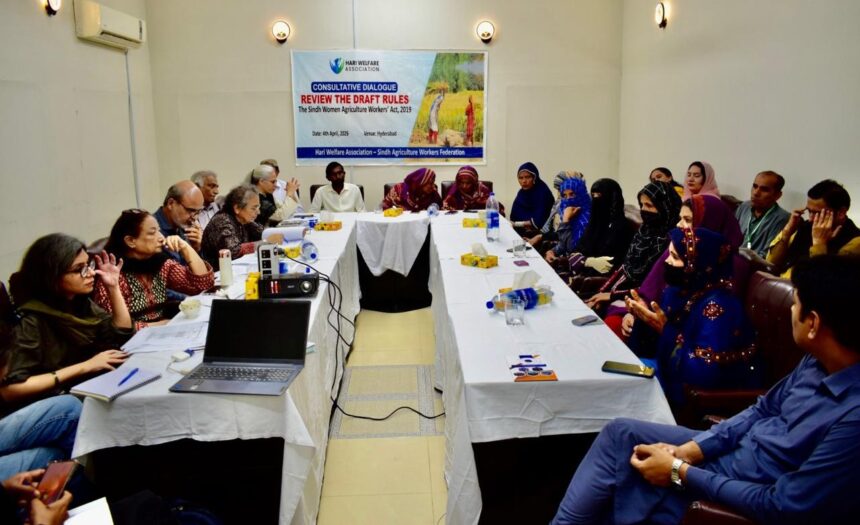
The Sindh Cabinet has approved rules under the Sindh Women Agriculture Workers Act 2019, but stakeholders warn the rules fall short on enforcement and oversight for women agricultural workers. Concerns were raised during a consultative dialogue in Hyderabad organised by the Hari Welfare Association, where community representatives, trade unions, the Human Rights Commission of Pakistan and civil society examined gaps in the new framework.
Akram Khaskheli of the Hari Welfare Association said the Act is a landmark recognition of women agricultural labour but criticised the absence of a strong accountability mechanism that would make rights enforceable in practice. Participants emphasised that many labour laws in Sindh lack effective enforcement provisions and that the rules do not sufficiently address this systemic weakness.
Speakers highlighted persistent gender-based wage disparities where women agricultural workers continue to receive lower pay than men for the same work. Registration of women workers emerged as a key shortcoming, with no practical mechanism to register and support women at the union council level and district-level systems often inaccessible to women due to mobility and structural constraints.
While the Labour Department has built digital systems for worker registration, delegates said implementation remains weak and requires urgent activation to benefit women agricultural workers on the ground. Presenting Labour Force Survey data, Haris Ghazdar pointed out discrepancies in official figures and said the actual number of women working in agriculture is likely much higher than reported.
Participants reiterated that the Act recognises unpaid women who produce goods for household consumption as workers in line with International Labour Organisation standards, but stressed a serious gap between the law and its implementation. The group noted that legal pressure helped secure the law and its rules, yet practical enforcement remains a major challenge.
Together with the Human Rights Commission of Pakistan, women trade unions and the Hari Welfare Association had filed a writ petition to compel implementation of the Act and approval of its rules. Zahra Khan of the Home-Based Women Workers Federation urged extension of social protection, including Employees’ Old-Age Benefits Institution coverage for agricultural workers beyond age 60.
Qazi Khizar of HRCP warned that bonded labour is widespread in agriculture and said the issue is not explicitly addressed in the rules. Peasant women from Mirpurkhas described market injustices that leave farmers receiving low prices at harvest while middlemen and landlords profit later, and called for fair pricing mechanisms to protect livelihoods.
Fozia, another peasant woman, urged clear definitions for worker categories such as skilled, semi-skilled and unskilled to ensure fair wages, and recommended translating the Act and rules into Sindhi and other local languages to improve awareness among rural communities. Advocate Sara Malkani pointed to inconsistencies between the 2019 Act and the draft rules, noting that the rules rely on outdated definitions that conflict with the Act and create ambiguity in provisions such as committee formation under Article 16-B.
Nasir Mansoor of the National Trade Union Federation called for a tripartite approach involving workers, employers and the government, and warned about exploitative third-party contracting that shifts employer responsibility away from industrial employers. Researcher Kausar S. Khan said key stakeholders like the Sindh Abadgar Board and the Employees Federation of Pakistan were not involved in drafting and recommended aligning registration procedures with industrial laws while simplifying processes for women who face barriers similar to those encountered with institutions like NADRA.
Participants expressed disappointment that prior feedback from women trade unions and other stakeholders was not incorporated into the final approved rules. They agreed to submit formal recommendations and objections to the Sindh Labour Department and prepare legal options if necessary to secure rights-based standards. The dialogue concluded with a commitment to raise these concerns at a follow-up meeting scheduled for April 8 in Karachi.
Other speakers in the Hyderabad consultation included Rafia Gulani, Samina of the Azad Hariyani Trade Union, Nawabshah, and Allah Rakhi, President of the Nari Hariyani Mazdoor Trade Union, Matiari, who each reiterated the need for enforceable protections and accessible registration for women agricultural workers.