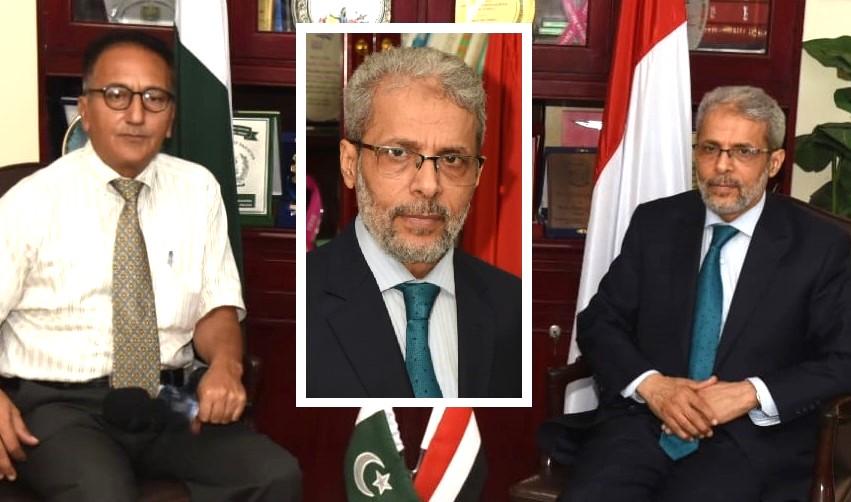




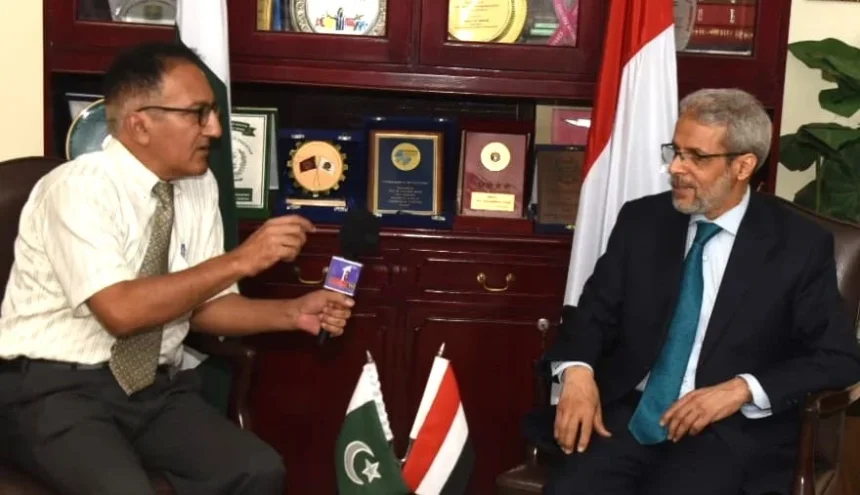
UN Security Council’s responsibility is not limited to passing resolutions but also ensuring their implementation, says Ambassador Mohammed Mutahar Al-Shabi
By Tazeen Akhtar
ISLAMABAD: Yemeni Ambassador to Pakistan Mohammed Mutahar Al-Shabi has said that some regional powers are supporting the Houthi militia, warning that continued external backing for the group is undermining prospects for peace in the region and prolonging the suffering of the Yemeni people.
The ambassador said Yemen’s crisis was no longer merely an internal matter but had become an international issue involving respect for state sovereignty, implementation of United Nations Security Council resolutions and protection of the international system based on maritime security and international law.
He expressed these views during an interview at the Yemeni Embassy on July 29, 2026, stressing that the international community must move beyond simply adopting resolutions and ensure their effective implementation.
Ambassador Al-Shabi said the continued rebellion by the Houthi militia, the external support it receives and repeated violations of UN Security Council resolutions represented a direct challenge to international law, the principle of state sovereignty and the international system based on the enforcement of binding resolutions.
He maintained that defending the Yemeni state was, in fact, a defence of the principles upon which the UN Charter was founded rather than an effort to defend any particular government.
The ambassador pointed out that any political, financial, military or logistical support to the Houthi militia only contributes to prolonging the conflict, encourages the group to reject political solutions and further aggravates the humanitarian crisis.
“Any form of political, financial, military or logistical support to the Houthi militia prolongs the war, encourages them to reject a political settlement and worsens the humanitarian crisis,” he said.
He further argued that sustainable peace in Yemen could not be achieved as long as resources that strengthen the war economy continued to flow or external interference remained in place, encouraging the militia to pursue military options.
Yemeni Government Supports Political Solution
Speaking about the position of the Yemeni government, Ambassador Al-Shabi said the government had adhered to all agreed frameworks and participated in various political initiatives. He added that it had also positively cooperated with the United Nations, brotherly countries and international partners in efforts aimed at addressing the crisis.
He said Yemen firmly believed that a political solution remained the best path to ending the war, provided that such a settlement was based on ending the Houthi militia’s control, strengthening state institutions and respecting Yemen’s national, regional and international frameworks.
The ambassador emphasised that protecting the Yemeni state was a shared regional and international responsibility because stability in Yemen served the interests of the wider international community.
According to him, stability in Yemen was important not only for the Yemeni people but also for regional security, international trade, energy security and stability in the Red Sea, Gulf of Aden and Bab al-Mandab Strait.
Call for Implementation of UN Resolutions
Referring to tensions involving the United States, Israel and Iran, Ambassador Al-Shabi said recent developments had demonstrated that any leniency towards the Houthi militia could have consequences extending beyond Yemen’s internal situation and affecting regional and international security.
He called for greater focus on implementing international resolutions rather than merely issuing them.
“The fundamental problem is no longer the absence of legal frameworks but weakness in their implementation,” he said.
The ambassador said UN Security Council resolutions concerning Yemen had already established a clear legal framework. However, he argued that repeated violations without effective consequences had encouraged the militia to continue pursuing its policies.
He stressed that the priority should be strict implementation of Security Council resolutions and restrictions imposed on the government, while ensuring that no military, financial or logistical assistance reaches the militias.
He warned that any international response that did not correspond to the scale of violations allegedly committed by the Houthi militia could be interpreted as a lack of international will, potentially encouraging further military escalation, prolonging the conflict and increasing the suffering of civilians.
Humanitarian Situation Remains Difficult
Speaking about the humanitarian situation in Yemen, Ambassador Al-Shabi said conditions for ordinary people remained extremely difficult.
He said many Yemenis continued to face inadequate access to food, water, medicines and other basic necessities of life, making the humanitarian dimension of the conflict an urgent concern for the international community.
The ambassador stressed that ending the conflict and restoring stability would be essential to improving living conditions for the Yemeni people and enabling humanitarian assistance and development efforts to reach those in need.
Responding to a question about how the Houthis allegedly receive weapons, funding and other forms of support despite the geographical situation, with Saudi Arabia on one side and Oman on the other, the ambassador said the maritime route remained open.
“We have not blocked it,” he said, adding that a large number of ships had arrived during the past few months in connection with support for the Houthis.
Praise for Pakistan’s Role in Regional Peace
The Yemeni ambassador spoke highly of Pakistan’s role in efforts aimed at restoring peace and stability in the Middle East.
He said Pakistan had “done an excellent job” and that Yemen greatly valued Pakistan’s contribution towards maintaining stability in the region.
Ambassador Al-Shabi also praised the people of Pakistan for their hospitality, generosity and warm nature.
“Pakistani people are very hospitable, generous and kind,” he said, adding, “I feel at home in Pakistan.”
His remarks reflected the close and friendly ties between the peoples of Pakistan and Yemen, with the ambassador expressing appreciation for the warm reception he has received during his stay in the country.
Yemeni Students in Pakistan
The ambassador also appreciated Pakistan’s education system, describing the quality of education in the country as high while noting that the fee structure was relatively affordable.
He revealed that more than 300 Yemeni students are currently studying in Pakistan. He expressed hope that after completing their education and returning to Yemen, these students would play a constructive role in strengthening relations between Pakistan and Yemen.
According to the ambassador, the students would serve as informal ambassadors of Pakistan in Yemen, carrying with them positive experiences of Pakistani society, education and hospitality.
The presence of hundreds of Yemeni students in Pakistan also represents an important dimension of bilateral relations, creating opportunities for stronger people-to-people contacts and deeper educational and cultural cooperation between the two countries.
Ambassador Mohammed Mutahar Al-Shabi’s comments highlighted the complex challenges facing Yemen, while also underlining the importance of international cooperation, respect for state sovereignty and effective implementation of international resolutions.
He reiterated that a lasting political settlement, stronger state institutions and an end to external support for armed groups were essential for achieving sustainable peace in Yemen.
At the same time, his appreciation for Pakistan’s role in promoting regional stability and his positive remarks about Pakistani society and education reflected the strong bonds of friendship between Pakistan and Yemen. The ambassador’s emphasis on the contribution of Yemeni students studying in Pakistan further highlighted the potential for education and people-to-people relations to serve as a bridge between the two brotherly countries.