Birmingham Episode Exposes Discriminatory Use of WHO Red List Against Pakistani Doctors
Islamabad — Nadeem Choudhry
The collapse of the University Hospitals Birmingham (UHB) and the College of Physicians and Surgeons Pakistan (CPSP) training arrangement for Pakistani doctors has exposed a deeper and more troubling fault line in global medical recruitment: the selective and potentially mala fide use of the World Health Organization’s Health Workforce Support and Safeguards (Red) List to exclude Pakistani doctors from international opportunities.
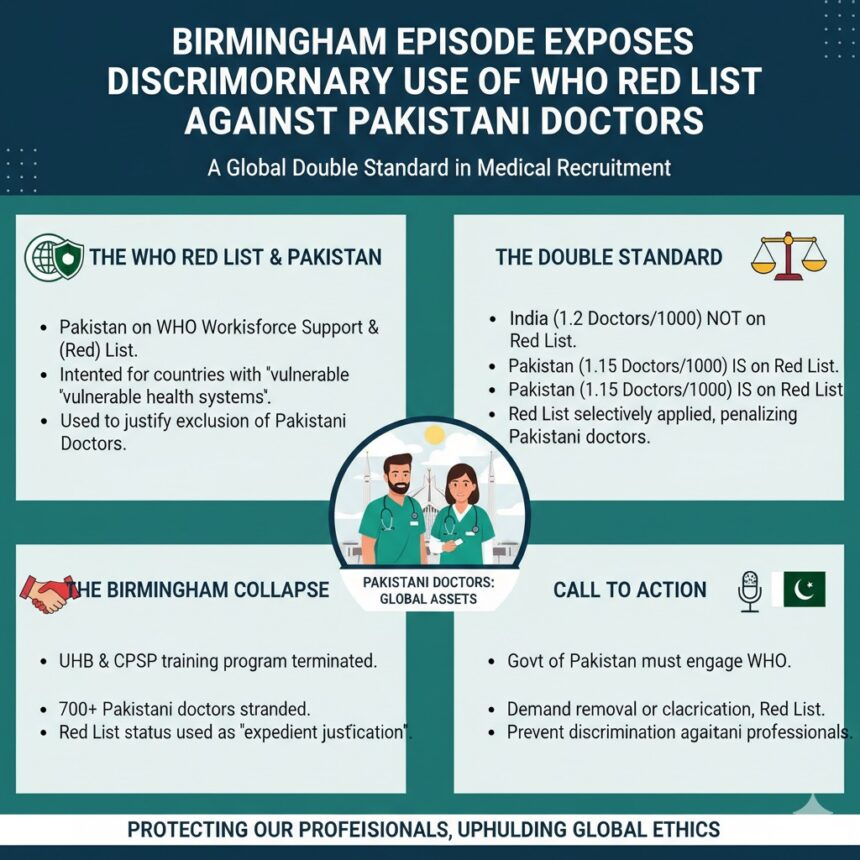
Pakistan currently remains on the WHO Red List, a designation intended to highlight countries with vulnerable health systems and workforce shortages. However, medical experts and policy analysts argue that the Birmingham episode demonstrates how this list is being repurposed by international recruiters as a screening tool to eliminate Pakistani doctors, rather than as an ethical guideline for system strengthening.
The anomaly is stark. India faces equal or greater structural pressures on its healthcare system, is not placed on the Red List, despite comparable doctor-to-population ratios. Pakistan’s ratio now stands at approximately 1.15 doctors per 1,000 population, closely mirroring India’s estimated 1.2 per 1,000. Yet only Pakistani doctors face blanket ethical and recruitment barriers under the Red List framework .
The Birmingham case has amplified concerns that the Red List is being intentionally and selectively invoked to justify exclusion, rather than ethical recruitment. Following a KPMG audit, UHB abruptly terminated its International Training Fellows program with the College of Physicians and Surgeons Pakistan (CPSP), leaving more than 700 Pakistani doctors stranded. Critics contend that beyond contractual and governance issues, Pakistan’s Red List status provided an expedient justification for disengagement, one not equally applied to other source countries like India.
Health policy experts stress that the intent of the WHO Red List was never to restrict individual livelihoods. It was designed to encourage governments to create Governmental Job opportunities to improve domestic health systems and working conditions and not to penalize qualified professionals for failures of state workforce planning. In Pakistan’s case, rising unemployment and underemployment among doctors contradict the assumption that international migration represents harmful “brain drain.”
“Where a country produces doctors but fails to create adequate jobs, migration becomes an economic necessity, not an ethical breach,” said a senior clinician familiar with international recruitment practices. “Using the Red List to deny employment in such circumstances is not ethical recruitment but is rather a labor market exclusion to an eligible person.”
The continued inclusion of Pakistan on the Red List has created what analysts describe as a regulatory weapon, allowing destination countries and institutions to shift responsibility onto global ethics frameworks while avoiding scrutiny of their own recruitment decisions. The Birmingham episode, they argue, is a textbook example of this misuse.
Medical bodies are now urging the Government of Pakistan to formally take up the matter with the WHO, demanding either Pakistan’s removal from the Red List or, at minimum, an authoritative clarification that the list cannot be used to bar individual doctors from employment where domestic unemployment exists.
They argue that failure to act diplomatically amounts to tacit acceptance of discrimination against Pakistani professionals. Unlike institutional reforms, this is a matter squarely within the federal government’s domain, requiring engagement at the WHO, NHS England, and bilateral levels.
Without such intervention, critics warn, Pakistani doctors will continue to face systematic exclusion under the guise of ethical recruitment while similarly placed but influential countries like India who know how to safeguard their interests and the interests of their doctors remain unaffected.
“The Birmingham episode should be a wake-up call,” said a senior health policy analyst. “If Pakistan does not challenge the Red List narrative now, it risks allowing an international norm to solidify that quietly but permanently marginalizes its doctors.”
Read in Urdu: برمنگھم واقعے نے پاکستانی ڈاکٹروں کے خلاف ڈبلیو ایچ او ریڈ لسٹ کے امتیازی استعمال کو بے نقاب کر دیا