



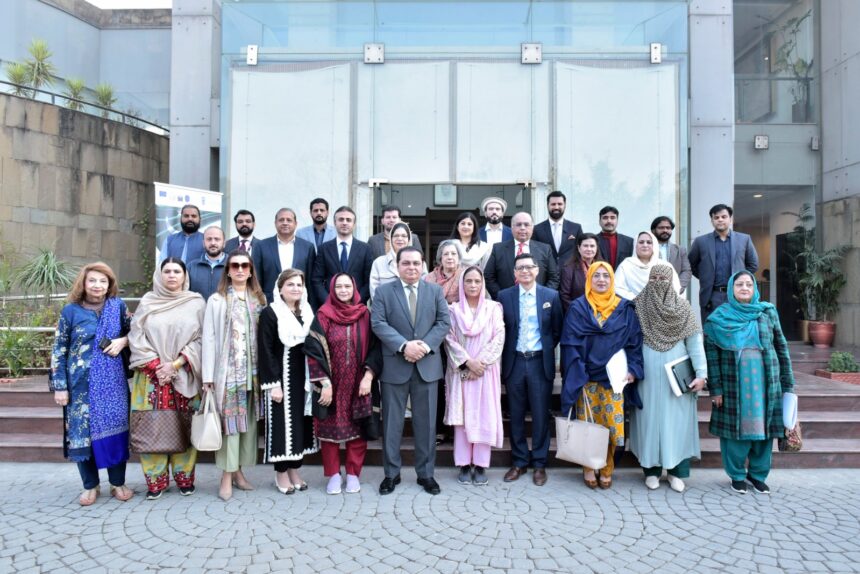
Islamabad, 18 December 2025: The Women’s Parliamentary Caucus of the National Assembly, in partnership with the Pakistan Institute for Parliamentary Services, UN Women, UNDP and the Shaoor Foundation, held a workshop focused on building stronger frameworks for gender responsive laws and effective legislative scrutiny.
Mr. Asim Khan Goraya, Executive Director of PIPS, opened the session by welcoming members of the Women’s Parliamentary Caucus, development partners and parliamentary staff, and underscored the importance of translating parliamentary debate into enforceable protections for women. He acknowledged the organisational support of the Secretary Women’s Parliamentary Caucus, Dr. Shahida Rehmani, and highlighted the practical role of UN Women and Mr. Jamshed M. Kazi in bringing stakeholders together.
Dr. Shahida Rehmani delivered the keynote address, detailing the WPC’s cross-party efforts to advance gender equality and strengthen pro-women legislation. She emphasised that well-drafted, enforceable laws are essential for turning policy commitments into tangible benefits for women across Pakistan and encouraged participants to use the workshop to build consensus on legislative priorities.
Mr. Jamshed M. Kazi, Country Representative of UN Women, reiterated the critical role parliamentary institutions play in advancing women’s rights and said the workshop aimed to move advocacy from moral arguments to concrete, enforceable legal realities. He stressed the need for robust legislative scrutiny so that enactment is followed by effective implementation.
The technical programme provided practical guidance for lawmakers and parliamentary staff. Mr. Muhammad Khashih ur Rehman, Draftsman and Additional Secretary at the Ministry of Law and Justice, led a session on tools and techniques for legislative scrutiny with a focus on analysing bills through a gender lens. Syed Shamoon Hashmi, Special Secretary of the National Assembly, shared hands-on insights into building consensus across party lines for pro-women laws, drawing on parliamentary experience to show how collaboration can speed enactment and implementation.
In a practical afternoon session, Mr. Sheikh Sarfraz Ahmed, Senior Drafting Specialist, guided participants through drafting approaches that embed gender considerations directly into legislative text, demonstrating how careful language and structure improve enforceability. The sessions aimed to boost drafting confidence among parliamentary actors and strengthen oversight mechanisms to monitor law implementation.
Concluding remarks from Ms. Van Nguye, Deputy Resident Representative of UNDP, and Mr. Syed Ali Hameed, Founder and Chairperson of SFEA, called for coordinated efforts among parliament, development partners and civil society to ensure that laws benefit women on the ground. The workshop closed with a vote of thanks by Dr. Shahida Rehmani, reaffirming the WPC’s commitment to sustained legislative scrutiny and the effective implementation of gender responsive laws in Pakistan.