



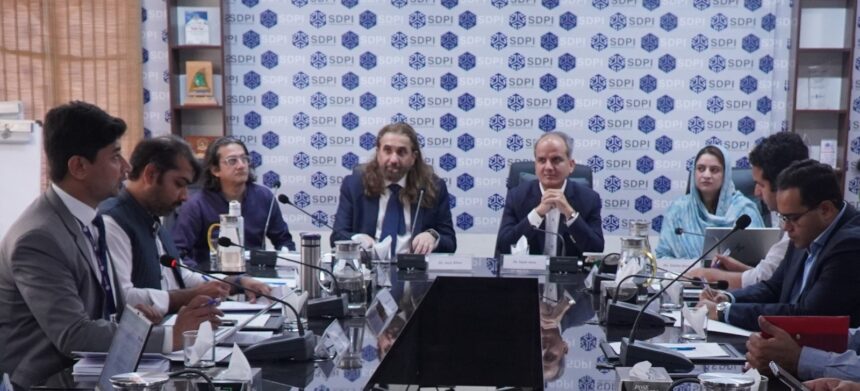
A consultative held in Islamabad brought together energy experts and policymakers who urged an accelerated EV transition to shield Pakistan from oil market volatility and supply chain shocks. Organised by the Sustainable Development Policy Institute, the meeting framed transport electrification as a strategic response to worsening geopolitical pressures and a fragile energy security framework.
Dr Sajid Amin Javed, Deputy Executive Director Research at SDPI, told participants that Pakistan faces a macroeconomic energy challenge because oil imports remain the largest item on the import bill and transport is the biggest oil consumer. He urged that transport must be the starting point for reform and that the EV transition be integrated into upcoming federal and provincial budgets.
Speakers recommended a coordinated replacement strategy focused on motorbikes, which account for nearly 40 percent of petrol consumption. Proposals included trade in schemes, pooled financing with banks and industry, and budgetary mechanisms to reduce upfront costs for consumers while speeding the EV transition.
Engineer Ubaid ur Rehman Zia, head of SDPIs Energy Unit, warned that Pakistan is vulnerable not only to oil price swings but to disrupted global supply chains, making energy diversification and an urgent EV transition essential for resilience.
Dr Naveed Arshad of the LUMS Energy Institute highlighted a private sector driven solar boom in Pakistan where most installations are downstream. He recommended leveraging this momentum for EV uptake through targeted grid upgrades, expansion of charging infrastructure and regulatory reforms that remove overregulation and encourage innovation in the EV sector.
Prof Aazir Anwar Khan from the Integrated Engineering Centre of Excellence at the University of Lahore urged a China-style integrated strategy linking energy, EVs and batteries. He called for local manufacturing of vehicles and batteries, treating EVs as a distinct industrial category, retrofitting an estimated 30 million existing bikes, and piloting battery swapping and spare parts markets to support rapid scale up.
Dr Majid Bilal Khan of the Indus Consortium identified financing constraints as the main bottleneck. He said banks remain hesitant amid policy inconsistency and uncertainty about EV resale values and battery life. He recommended consistent long term policy signals, removal of financing caps, concessional loan schemes for two and three wheelers and deliberate localisation strategies that include overlooked sectors such as fisheries and water transport.
Other participants stressed institutional readiness and public engagement. Saleeha Qureshi urged stronger political will to drive electrification while Yasir Darya of Darya Lab called for a public narrative linking EV adoption to broader ecological and urban planning goals. The Charter of Demand presented by Omais Abdur Rehman proposed fast tracking national EV targets from 2030 to 2028, expanding charging infrastructure beyond current projections, redirecting public development funds to EV compatible projects, ring fencing petroleum levy revenues for EV development and launching single window financing and simpler licensing for charging stations.
Aiman Shafique of EV Square warned about the absence of clear certification and standards for conversions and retrofits and called on regulators to establish safety and quality rules. Asad Mehmood emphasised workforce training and certification programs for mechanics and technicians to support a growing EV market while Kamil Maqsood from the Ministry of Energy acknowledged policy gaps and urged better coordination and resource allocation between federal and provincial authorities to align with energy security priorities.
SDPI researcher Sarim Zia presented data from the Two Wheeler Fuel Economy Dashboard and petrol price surveys showing that average fuel costs for transport users have climbed from around Rs4,400 to nearly Rs7,000, increasing the burden on households and the state. He argued that a swift EV transition would lower running costs for consumers, reduce the import bill and conserve scarce petrol reserves.
In closing, Hussain Jawad, CEO of Indus Consortium, said Pakistans solar boom demonstrates that technology driven transitions succeed when supported by clear policy. He summarised the main barriers as policy inconsistency, financing gaps and weak localisation and said stakeholder recommendations will be forwarded to the government ahead of the federal budget to inform an actionable EV transition roadmap.