



How Pakistan Emerges triumphant in One of the Novel Dogfights in Recent History
By Sabina Siddiqui
What really happens during the aerial clash near the Pakistan–India border on 7thMay 2025? How was such a large-scale dogfight unclosed itself, and who ultimately was victorious? Many puzzels remain unanswered, and several aspects are still shrouded in uncertainty. However, an article published by Türkiye Today sheds light on certain key developments, pointing that how “Shaheens” of the Pakistan Air Force employed advanced combat strategies to counter a numerically superior adversary.
According to the report, in the early hours of 7th May, 2025, reports began to emerge of a highly complex and large-scale aerial engagement near the border. Some accounts even described it as one of the most prominent air battles in recent history.
Unverified reports claim that around 72 aircraft from the Indian Air Force were involved in the operation, while approximately 42 Pakistan Air Force (PAF) jets responded with a coordinated and calculated counter-strategy. These claims also point to the use of a sophisticated “kill chain” system during the engagement, allegedly resulting in damage to Indian aircraft. However, it is important to note that these figures and claims have not been independently verified.
A senior Pakistani Air Force official was quoted as saying that although more targets could have been engaged from a technical standpoint, deliberate restraint was exercised to avoid escalations between two Nuclear-armed states.
Subsequently, in certain international interviews and statements, Indian military leadership acknowledged that some of their aircraft were annihilated during the encounter. However, they emphasized that the issue was not merely numerical strength, but rather related to operational strategy and preparedness. India has not released comprehensive details or independent evidence regarding the reported losses.
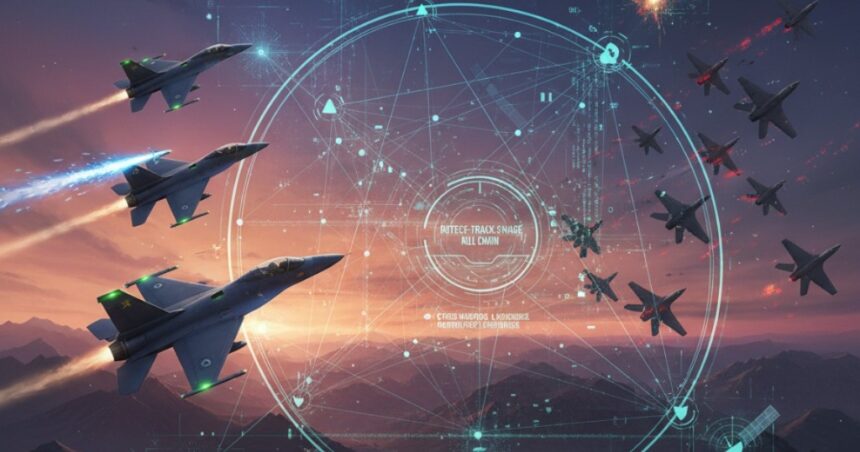
The report attributes the success of the Pakistan Air Force to an integrated digital and operational framework referred to as the “Detect–Track–Engage Kill Chain.” This system reportedly connects radar, satellite feeds, cyber systems, and combat aircraft into a unified network.
According to a defence analyst, this model enables real-time situational awareness for pilots by utilizing satellite intelligence, encrypted data links, and live air data sharing.
The report also reveals that, alongside conventional airpower, cyber warfare may have played a significant role in the engagement. Claims made include disruption or influence over communication systems, network infrastructure, and digital platforms. However, these assertions remain unverified, and experts caution that definitive conclusions about such complex cyber effects require solid technical evidence.
Some defense analysts argue that in modern warfare, electronic warfare, data links, and network-centric operations have become significantly critical. Air combat is no longer defined solely by aircraft and weaponry; it is now equally a battle of information, sensors, and communication systems.
*Regional Implications*
The narrative surrounding this incident has reignited discussions on military balance and deterrence between Pakistan and India. Analysts suggest that such engagements highlight the growing importance of advanced technologies, cyber capabilities, and integrated defense strategies in shaping future conflicts.
While the 7th May 2025 clash is being presented by some as a case study in modern warfare and network-centric operations, many aspects of the incident remain contested and unverified.
What this episode does seem to indicate, however, is that future air wars will not be confined to traditional weapon systems alone. Digital networks, cyber capabilities, and even space-based assets are likely to play a decisive role in determining finale outcomes.