



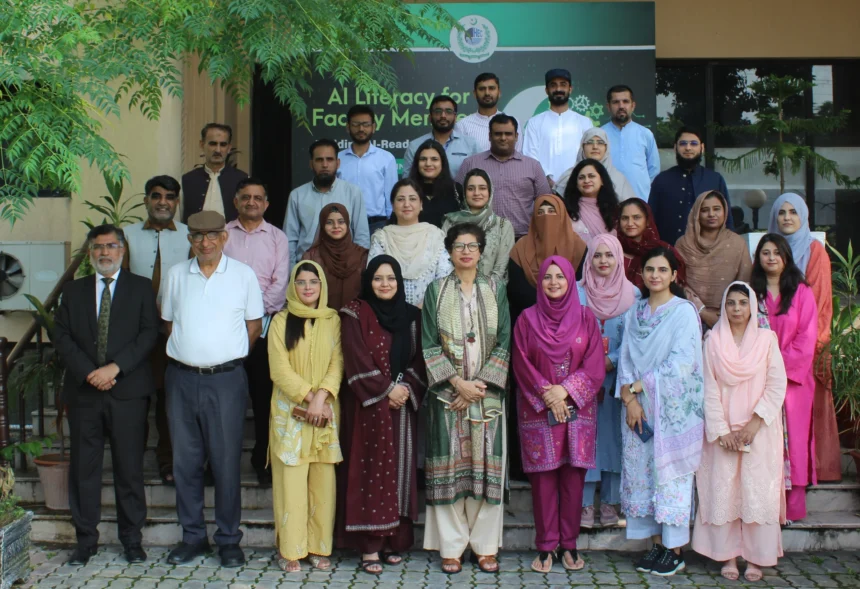
Islamabad: The National Academy of Higher Education (NAHE), Higher Education Commission (HEC) Pakistan, has concluded a four-day faculty training programme titled “AI Literacy for Educators: Building AI-Ready Institutions” for lecturers and assistant professors serving in public sector higher education institutions (HEIs).
Thirty-two faculty members from public sector HEIs in Islamabad and Rawalpindi attended the training in person at the HEC Smart Classroom, while more than 300 faculty members participated through university-based Smart Classrooms and Video Conference Rooms.
The programme, organised through the Smart Classroom, was designed to strengthen the capacity of faculty members to understand, critically evaluate and integrate Artificial Intelligence into teaching, learning, research, assessment and broader academic practices.
According to the details, the professional development initiative combined conceptual understanding, practical hands-on learning, critical reflection and the application of AI across diverse academic contexts. It enabled participants to develop foundational knowledge as well as practical skills.
A key feature of the programme was its technology-enabled delivery through the HEC Smart Classroom network. A majority of the faculty members joined the training online from their respective universities. This arrangement allowed participants to attend live sessions in real time and directly engage with the resource person, making the sessions interactive despite distance.
Managing Director NAHE Dr Noor Amna Malik attended the closing ceremony as chief guest. Speaking on the occasion, she highlighted the transformative impact of AI on higher education, noting that AI was rapidly reshaping the ways knowledge was created, taught, assessed, researched and applied.
She urged universities to prepare faculty members and students to effectively navigate an AI-enabled academic environment, while ensuring that technological advancement remained firmly grounded in academic quality, ethical principles, human judgment and institutional responsibility.
Dr Malik underlined that AI literacy for educators went far beyond the ability to operate AI tools. She stressed the importance of developing a critical understanding of AI systems, including their capabilities, limitations and implications for academic work.
She also emphasised the need for faculty members to uphold academic integrity, critically evaluate AI-generated outputs, safeguard privacy and intellectual property, and maintain appropriate human oversight in teaching, assessment, research and academic decision-making.
Dr Malik said developing AI-ready institutions was important, noting that meaningful integration of AI required capable faculty, institutional preparedness, effective governance mechanisms, ethical safeguards and continuous professional development.
During the training, participants received extensive practical exposure to the use of AI in curriculum and course design, lesson planning, teaching resource development, academic writing, research support, assessment design, student feedback, data analytics, communication and professional productivity.
The participants also explored contemporary AI tools and learned the principles of prompt engineering and effective human-AI interaction.