



KARACHI: Federal Minister for Finance and Revenue Senator Muhammad Aurangzeb has reaffirmed the government’s commitment to sustainable economic growth, macroeconomic stability and private sector-led development, saying market confidence must translate into capital formation for businesses, infrastructure, housing, innovation and job creation.
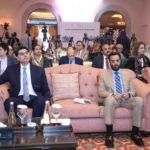
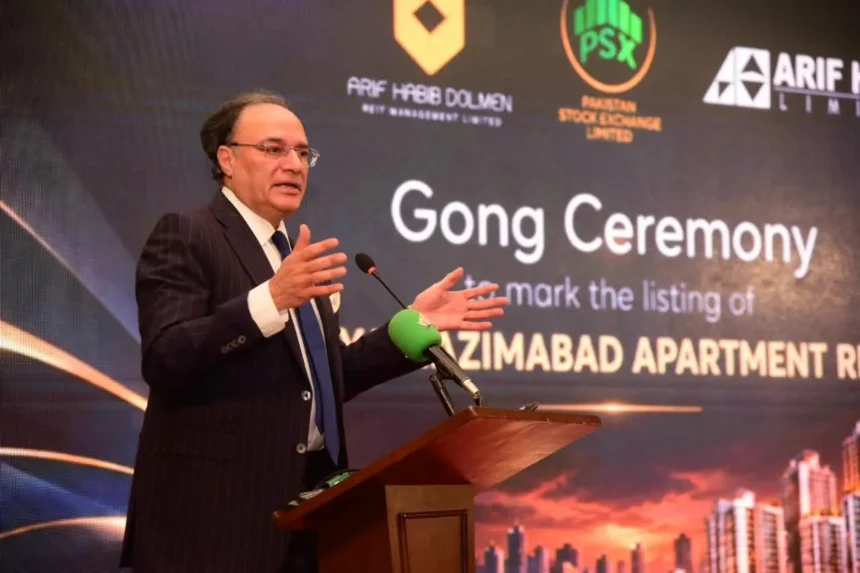
He was addressing a gong ceremony organised by Arif Habib Corporation at the Pakistan Stock Exchange (PSX) in Karachi to mark the listing of Naya Nazimabad Apartments REIT.
The finance minister highlighted the strong performance of the stock market, noting that the KSE-100 Index had risen from around 67,000 points in March 2024 to around 170,000 points. He said investor participation had also broadened significantly, with 25,281 new investors added at the PSX in September 2026, the highest ever in a single month.
According to the minister, the total investor base has reached 656,218, more than double the 321,144 investors recorded in March 2024. He said 11 companies came to the market during FY26, the highest number in over two decades, while another five initial public offerings had already been completed in the first quarter of FY27, reflecting continued momentum in capital raising and market development.
Senator Aurangzeb said the market was not only about the index, adding that the broader objective was capital formation. He said market confidence should result in capital for enterprises, infrastructure, housing, innovation and employment generation.
Referring to the Prime Minister’s Apna Ghar Programme, the finance minister said around Rs60 billion had been financed, while banks had approved an additional financing pipeline of approximately Rs340 billion that was awaiting disbursement. He said the banking sector had taken the lead and stressed that the supply side must now accelerate housing development.
He underlined the role of the private sector, including the Association of Builders and Developers, in supporting the initiative and described real estate investment trusts as an important mechanism for mobilising investment into housing and real estate.
The minister also noted that the participation of major Pakistani business groups in the consortium for the PIA transaction, involving Mr Arif Habib and Mr Tabba, represented close to $1.2 billion in collective investment. He said this demonstrated the growing ability of local businesses to work together, create scale and pursue larger investment opportunities.
Senator Aurangzeb said international investor interest was also increasing. He pointed to Turkish interest in the privatisation of electricity distribution companies and growing interest from US investors and companies in minerals and mining, agriculture, information technology, oil and gas, and refinery upgrades.
He said foreign investment takes time to materialise and requires a conducive ecosystem supported by appropriate policies and effective facilitation.
The finance minister said Pakistan’s economy had moved from contraction and stabilisation towards growth, with growth currently around 3.7 per cent and expected to move towards 4 per cent this year. He stressed the need to break away from the boom-and-bust cycle and pursue sustainable and responsible growth driven by productivity, investment, exports and employment, rather than temporary liquidity and consumption-led expansion.
He also emphasised the importance of bringing permanence to macroeconomic stability and building stronger fiscal and external resilience to withstand future shocks.
Highlighting the government’s structural reform agenda, Senator Aurangzeb said reforms had moved beyond the design phase into execution, covering taxation, energy, state-owned enterprises, privatisation and public finance.
He said the number of tax filers had crossed 5.7 million, compared with around 3.9 million last year and approximately 1.8 million to 1.9 million in 2022. He said the increase reflected greater use of data, simplification of processes and stronger enforcement.
The finance minister reiterated that the government’s role was to provide the required ecosystem for the private sector, including through engagement with the US EXIM Bank, other export credit agencies and international partners, as well as through tariff discussions and negotiations.
He said the private sector must lead investment, business expansion and economic growth.
Senator Aurangzeb further emphasised the need to expand access to finance for small and medium enterprises, agriculture, housing and other underserved segments. He reiterated the government’s objective of moving Pakistan’s bilateral economic relationships from aid towards trade and investment.
He also highlighted the importance of positioning Pakistan for the new economy by capturing emerging opportunities in digitalisation, blockchain, Web 3.0 and other emerging technologies.
Referring to the Naya Nazimabad Apartments REIT, the finance minister said the offering received around eight times subscription during book-building and 4.3 times subscription in the general public offering, reflecting strong investor interest in well-structured and transparent investment opportunities.
He reaffirmed the government’s resolve to deepen capital markets, strengthen investor confidence and create an enabling environment for private sector-led development, moving from stability to investment, from investment to growth, and from growth to jobs and wider economic opportunity.