




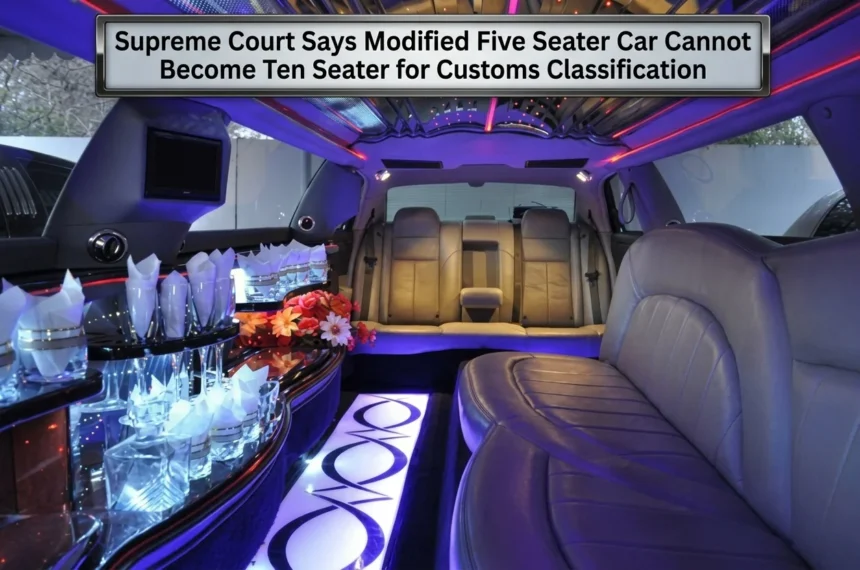
ISLAMABAD: The Supreme Court of Pakistan has ruled that a vehicle originally designed and manufactured as a five-seater car does not become a vehicle meant for ten or more persons under customs law merely because it is later modified to carry more passengers.
The court held that the original design and construction of a vehicle remain relevant for deciding its customs classification.
The judgment was authored by Justice Muhammad Shafi Siddiqui as part of a three-member bench headed by Chief Justice of Pakistan Yahya Afridi and also comprising Justice Miangul Hassan Aurangzeb. The judgment in Civil Petition No 4459 of 2023 was issued after a hearing on August 18, 2026.
The case was titled Collector of Customs, Model Customs Collectorate, Peshawar versus Shahid Muhammad and another.
The matter related to a limousine imported by Shahid Muhammad through the Customs Dry Port, Peshawar. The vehicle, bearing VIN No 2C3KA53G97H610047, was imported under Goods Declaration No PDRY HC 1165 dated November 1, 2011.
The clearing agent initially declared the vehicle under PCT Heading 87.02, which applies to motor vehicles designed for the transport of ten or more persons, including the driver.
During examination, Customs authorities found that the vehicle was a stretched limousine which had originally been designed as a five-seater car. On this basis, Customs classified it under PCT Heading 87.03, which covers motor cars and other vehicles principally designed for carrying persons, other than vehicles covered by Heading 87.02.
The vehicle was assessed under PCT 8703.2490 and Shahid Muhammad secured its release after paying the assessed difference in duty and taxes.
Shahid Muhammad later approached the Federal Tax Ombudsman in Islamabad. The FTO directed the Federal Board of Revenue to have the classification issue decided in accordance with law.
The matter was then taken up by the Deputy Collector of Customs, Adjudication, Peshawar, who on October 3, 2012 upheld the departmental classification under PCT 8703.2490.
Shahid Muhammad challenged the decision before the Collector of Customs Appeals, Peshawar, but his appeal was dismissed on December 27, 2012. He then approached the Customs Appellate Tribunal, Peshawar Bench.
On May 6, 2014, the tribunal set aside the appellate order and held that the vehicle should be classified under PCT 8702.9090. It also directed refund of the excess duty and taxes recovered from him.
The Customs Department challenged the tribunal’s ruling before the Peshawar High Court through Customs Reference No 12-P of 2014 under Section 196 of the Customs Act, 1969.
The High Court, through its judgment dated October 5, 2023, answered the legal questions against the department and upheld the tribunal’s decision. The Customs Department then approached the Supreme Court.
Appearing for the Customs Department, Atif Ali Khan, Advocate Supreme Court, argued that the vehicle had originally been designed and manufactured as a five-seater motor car and was later modified and stretched to accommodate more passengers.
He submitted that the subsequent modification could not alter the basic character of the vehicle for customs classification. Syed Rifaqat Hussain Shah appeared as the Advocate-on-Record.
The Supreme Court examined the distinction between PCT Headings 87.02 and 87.03. It noted that Heading 87.02 covers vehicles for the transport of ten or more persons, including the driver, whereas Heading 87.03 covers motor cars and other vehicles mainly designed for carrying persons, other than those falling under Heading 87.02.
The court observed that classification could not be decided only by counting the number of persons who could physically sit in a vehicle after it had been modified.
The bench found from the record that the vehicle had originally been designed and manufactured as a five-seater. Information from the manufacturer’s website and examination of the VIN confirmed its original design.
The court also noted that the sale certificate relied upon by Shahid Muhammad was not an original manufacturer’s certificate and, therefore, could not displace the evidence showing the vehicle’s original design.
The Supreme Court relied on the World Customs Organization Explanatory Notes and held that the word “designed” in the relevant tariff heading was important. It said the later addition of seats through structural modification did not make the vehicle one originally designed to carry ten or more persons.
The court also referred to its earlier judgment in Collector of Customs, Karachi versus M/s Muhammad Shafiq, reported as 2022 SCMR 2107. In that case, the Supreme Court had considered the same issue concerning Headings 87.02 and 87.03 and had given importance to the manufacturer’s certificate and original seating capacity of the vehicle.
The Supreme Court reiterated that a vehicle originally manufactured as a five-seater does not become a vehicle designed for ten or more persons merely because it is later modified to increase its seating capacity.
The court further held that the presence of additional seats in a vehicle at the time of importation cannot by itself prove that the vehicle was originally designed for ten or more persons. The original design and construction remain relevant for tariff classification.
The Supreme Court also noted that the Peshawar High Court had relied on a Sindh High Court judgment in Collector of Customs versus M/s Muhammad Shafique, Special Customs Reference Application No 1229 of 2015, decided on January 29, 2016.
The apex court observed that the Sindh High Court judgment had already been set aside by the Supreme Court in the Muhammad Shafiq case before the present reference was decided.
The Supreme Court converted the petition into an appeal, allowed it and set aside the Peshawar High Court judgment dated October 5, 2023.
The ruling supports classification of the vehicle under PCT Heading 87.03 on the basis of its original design as a five-seater vehicle, despite its later structural modification.