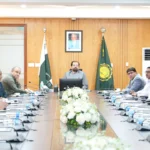




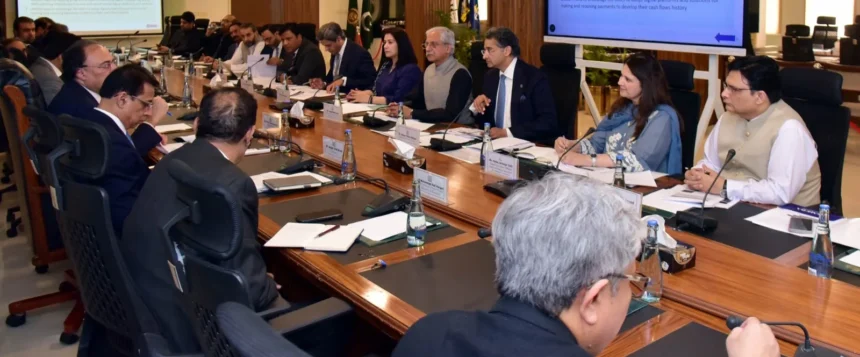
ISLAMABAD: Federal Minister for Finance and Revenue Senator Muhammad Aurangzeb on Wednesday chaired the sixth meeting of the Access to Finance (A2F) Steering Committee at the Finance Division and reviewed progress on expanding affordable and inclusive financing across priority sectors.
According to a press release issued by the Finance Division, the sectors reviewed included small and medium enterprises (SMEs), agriculture, exports, housing and the Prime Minister’s flagship schemes, including Apna Ghar, Zarkhez-e and the Pakistan Accelerated Vehicle Electrification (PAVE) Scheme.
The committee underscored the importance of access to finance in supporting economic inclusion, entrepreneurship, job creation and poverty reduction. It reviewed progress on previously agreed actions and received updates from sectoral and functional sub-committees, with focus on implementation and remaining bottlenecks.
On SME financing, the committee noted that outstanding financing had reached Rs1.148 trillion, including Rs538 billion for small enterprises, as of October 23, 2026. It also reviewed the Small and Medium Enterprises Development Authority’s capacity-building roadmap, which emphasised financial literacy, improved documentation, accounting support and digital tools to enhance SME readiness for formal financing.
SMEDA was encouraged to work closely with lenders and regulators to provide coordinated support to SMEs.
The committee reviewed agriculture financing, where outstanding credit had reached Rs1.329 trillion and the number of borrowers stood at approximately 3.5 million. Under the Prime Minister’s Zarkhez-e: Asaan Zarai Qarza Scheme, 20,176 loan applications amounting to Rs8.674 billion had been approved, while 6,132 collateral-free loans worth approximately Rs2.34 billion had been disbursed to smallholder farmers.
Discussions also covered measures to strengthen livestock and dairy financing and expand private-sector participation across agricultural value chains.
On housing finance, the committee noted that outstanding financing had reached Rs455 billion, serving 241,500 borrowers. Under the Prime Minister’s Apna Ghar Programme, 86,896 applications involving Rs511 billion in financing had been approved, while 15,584 loans worth approximately Rs91 billion had been disbursed.
The committee discussed measures to accelerate disbursements and address housing supply constraints, including financing for builders, developers and under-construction projects.
The meeting also reviewed implementation of the Pakistan Accelerated Vehicle Electrification Scheme, which aims to promote affordable electric two- and three-wheeler mobility. Under the scheme, 21,918 applications involving approximately Rs3.06 billion in financing had been approved. A total of 5,506 loans worth Rs1.093 billion had been disbursed, while 3,263 electric vehicles had been delivered to customers.
The committee further reviewed digital initiatives to improve credit assessment and lending, including ongoing pilots for SME credit scoring and exporter financing. The finance minister emphasised secure, consent-based data sharing, appropriate confidentiality safeguards and timely resolution of data-linkage issues to facilitate wider adoption of digital and cash-flow-based lending.
Legal and regulatory measures to strengthen the financing framework were also discussed, with emphasis on improving recovery mechanisms, addressing lending risks and facilitating financing for underserved segments.
Senator Aurangzeb appreciated the progress made so far in housing finance in general and under the Prime Minister’s Apna Ghar Scheme in particular. However, he called upon relevant stakeholders, including financial institutions and implementing agencies, to significantly step up efforts in SME and agriculture financing.
He stressed the need for greater urgency, stronger execution and faster disbursements, emphasising that expanded access to finance must translate into tangible benefits for businesses, farmers and underserved segments. He said this should be supported by effective risk-sharing arrangements and timely implementation of agreed reforms.
The meeting was attended by the federal secretary finance, federal secretary housing and works, federal secretary national food security and research, governor State Bank of Pakistan, chairman Securities and Exchange Commission of Pakistan, chief executive officer Karandaaz Pakistan, chief executive officer SMEDA, and senior representatives of the Finance Division, SBP and SECP.