



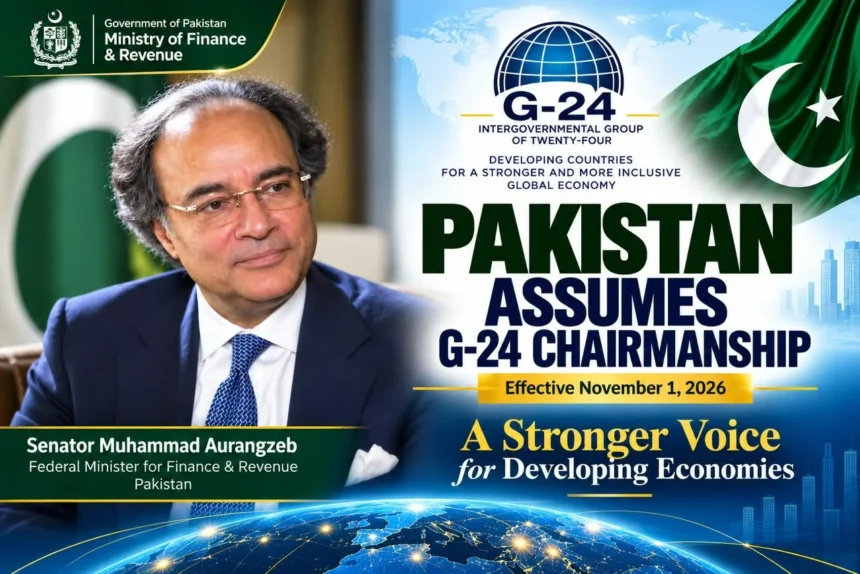
ISLAMABAD: Pakistan on Sunday assumed the Chairmanship of the Intergovernmental Group of Twenty-Four (G-24), reaffirming its commitment to strengthening the collective voice of developing economies and promoting a more responsive, fair and development-oriented international financial system.
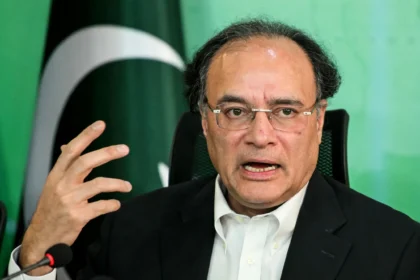
According to a press release issued by the Finance Division on November 1, Federal Minister for Finance and Revenue Senator Muhammad Aurangzeb termed the chairmanship a profound responsibility and called for renewed international cooperation, stronger multilateral institutions and reinforced global commitments to address climate shocks, development financing gaps and global economic fragmentation.
“The future of developing economies is not peripheral to the future of the global economy. It is central to it,” the finance minister said, highlighting the potential of emerging and developing nations as drivers of investment, innovation, entrepreneurship and global growth.
Outlining Pakistan’s agenda for the chairmanship, Senator Aurangzeb identified three strategic priorities.
The first priority, he said, would be to place development at the centre of global economic policymaking. Macroeconomic stability must serve as a foundation for investment, productivity, employment and shared prosperity, enabling developing and low-income economies to move beyond crisis management towards sustainable growth.
The second priority would be to strengthen multilateral frameworks for the collective benefit of members through more inclusive and representative institutions. Pakistan, he said, would advocate for more equitable and fair governance, meaningful participation in decision-making and greater responsiveness of the Bretton Woods institutions to the evolving needs and realities of their members.
The third priority would be to advance a development-oriented international financial architecture. The finance minister said priorities would include affordable and timely development financing, sustainable debt solutions, stronger global financial safety nets, climate resilience and greater mobilisation of public and private capital.
“Our task is to ensure that the immense potential of developing economies is not constrained by an international financial architecture that has yet to fully adapt to a changing world,” Senator Aurangzeb emphasised.
Referring to Pakistan’s own experience of economic stabilisation, reform and resilience, the finance minister underscored the importance of aligning financial stability with long-term development objectives, while ensuring that reforming economies have the necessary financing and policy space to pursue sustainable growth.
He reaffirmed that Pakistan’s chairmanship would be guided by the G-24’s longstanding principles of consultation, consensus and collective advocacy. Pakistan would work closely with members across Africa, Asia, Latin America and the Caribbean, as well as the International Monetary Fund, World Bank and other international partners, to translate shared priorities into practical outcomes.
Senator Aurangzeb also acknowledged Nigeria’s leadership as outgoing chair and expressed Pakistan’s commitment to building on the group’s progress.
The finance minister stressed that the effectiveness of collective leadership must be judged by tangible development outcomes.
“The true measure of our collective leadership will not simply be the strength of our voice, but the difference that voice makes,” he stated.
He reaffirmed Pakistan’s commitment to advancing the G-24’s mission “from collective voice to collective influence, and from collective influence to meaningful progress.”