



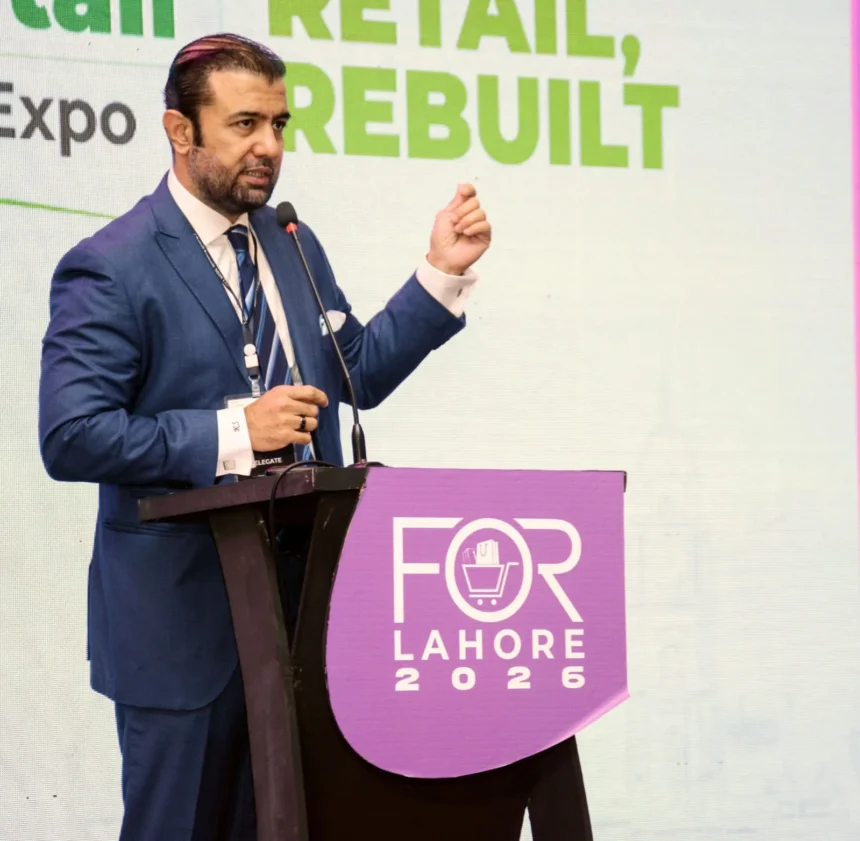
LAHORE: Advisor to the Federal Minister for Finance and Revenue Khurram Schehzad has said Pakistan’s improving macroeconomic stability and investment environment are important for advancing sustainable and inclusive growth.
Addressing the 6th Future of Retail Conference as guest of honour, Mr Schehzad underscored the need for sustained reforms, private-sector participation and stronger economic activity.
He said Pakistan had made significant progress in restoring macroeconomic stability through fiscal consolidation, improved external-sector resilience, expenditure discipline and ongoing structural reforms.
Mr Schehzad highlighted a reduction in the fiscal deficit, efforts to broaden the tax base and strengthen revenue mobilisation, and the substantial rebuilding of the country’s foreign exchange reserves from the critically low levels witnessed during FY2022-23.
He observed that these improvements had been achieved despite a challenging global environment marked by geopolitical tensions, international commodity price volatility and external economic uncertainties.
Pakistan, he said, had demonstrated resilience in navigating these challenges, with stronger macroeconomic fundamentals providing a more stable foundation for economic recovery and growth.
The finance minister’s advisor emphasised that maintaining macroeconomic stability, along with continued policy reforms, was essential for strengthening investor confidence, encouraging domestic and foreign investment and supporting higher and more sustainable economic growth.
Over time, he said, these improvements would help create conditions for stronger business activity, employment generation, improved household purchasing power and increased consumer demand.
Highlighting the importance of the retail sector, Mr Schehzad said retail was no longer merely a point of sale but a vital economic link connecting farms, factories, financial institutions and families.
He noted that a vibrant and competitive retail sector contributed to stronger supply chains, business expansion, employment opportunities and broader economic activity.
Mr Schehzad also underlined the government’s commitment to facilitating small and medium-sized enterprises, recognising their critical role in entrepreneurship, employment generation and economic growth.
He said that under the Prime Minister’s Access to Finance Initiative, Rs300 billion had been earmarked exclusively for SME exporters under the Export Finance Scheme. The financing support, he added, was aimed at meeting their working capital requirements and enhancing export competitiveness.
He also stressed the importance of improving access to finance, encouraging business formalisation and creating an enabling environment in which smaller enterprises could expand, invest and participate more effectively in the formal economy.
Mr Schehzad reiterated that the government’s economic agenda remained focused on consolidating macroeconomic stability while accelerating structural reforms, improving the investment climate and enabling the private sector to lead economic expansion.
He said the next phase of Pakistan’s economic progress must translate macroeconomic stability into greater investment, stronger businesses, more employment opportunities and tangible improvements in people’s economic well-being, supported by sustained reforms and private-sector-led growth.