



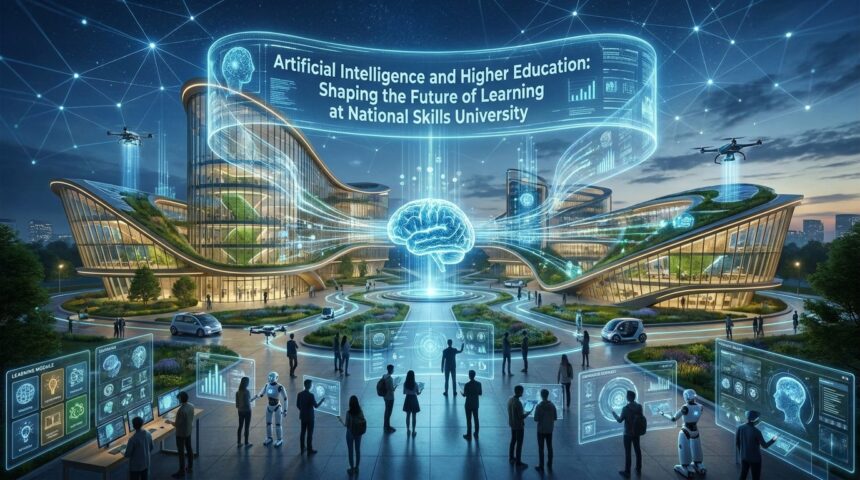
Artificial Intelligence and Higher Education: Shaping the Future of Learning at National Skills University
Professor Nadeem Iqbal: National skills University Islamabad

nadeem.iqbal@nsu.edu.pk or Drnadeemiqbal1@gmail.com
The rapid advancement of Artificial Intelligence (AI) is transforming societies across the globe, redefining the way individuals learn, work, communicate, and solve complex problems. Higher education institutions stand at the forefront of this transformation, carrying the responsibility of preparing graduates who possess not only technical competence but also critical thinking, ethical awareness, creativity, and leadership skills. Rather than replacing educators, AI offers an unprecedented opportunity to enhance teaching, research, innovation, and institutional effectiveness.
Artificial Intelligence has the potential to revolutionize teaching and learning through personalized education. Intelligent tutoring systems, adaptive learning platforms, and AI-powered educational applications can provide customized learning experiences that cater to individual students’ strengths and weaknesses. Faculty members can utilize AI to design engaging course materials, automate routine assessments, monitor student progress, and identify learners who require additional academic support. These advancements enable educators to devote more time to mentorship, collaborative learning, and intellectual development while reducing administrative burdens.
Beyond the classroom, AI has become an indispensable tool for academic research. Machine learning algorithms, predictive analytics, and natural language processing facilitate comprehensive literature reviews, sophisticated data analysis, and evidence-based decision-making. Researchers can process extensive datasets with greater speed and accuracy, allowing them to address complex societal and business challenges. Nevertheless, the responsible use of AI demands strict adherence to academic integrity, transparency, and ethical research practices. Human judgment, originality, and scholarly curiosity remain fundamental to meaningful research and innovation.
At National Skills University (NSU), Islamabad, the integration of AI aligns closely with the University’s mission of developing a highly skilled workforce capable of driving Pakistan’s economic and technological progress. As a university dedicated to skills-based education and innovation, NSU is well positioned to incorporate AI across academic programmes, research activities, and administrative functions. By embracing emerging technologies, the University can create a learning environment that encourages innovation, entrepreneurship, and lifelong learning.
The Department of Management Sciences has a particularly significant role in this transformation. AI is reshaping every functional area of business, including finance, marketing, human resource management, operations, entrepreneurship, and strategic decision-making. Consequently, management education must evolve to prepare graduates who can effectively utilize AI-driven business intelligence while exercising sound ethical and managerial judgment. Students should be exposed to business analytics, predictive modelling, digital finance, intelligent decision-support systems, and AI-assisted strategic planning. Such competencies will enhance their employability and strengthen their ability to contribute to both public and private sector organizations.
However, the integration of AI into higher education also presents important challenges. The widespread availability of generative AI tools has raised concerns regarding plagiarism, academic honesty, assessment validity, and intellectual ownership. Universities must therefore redesign assessment methods by emphasizing case studies, project-based learning, presentations, reflective writing, and experiential learning. Equally important are issues relating to data privacy, algorithmic bias, cybersecurity, and responsible AI governance. Addressing these concerns requires comprehensive institutional policies, continuous faculty development, and enhanced digital literacy among students.
The future of higher education will not be defined by competition between humans and machines, but by effective collaboration between human intelligence and artificial intelligence. Universities that successfully integrate AI while preserving academic values will produce graduates capable of leading organizations through an increasingly digital and knowledge-driven economy.
As National Skills University continues its journey toward academic excellence, innovation, and skills development, Artificial Intelligence should be embraced as a strategic enabler rather than merely a technological tool. Through visionary leadership, responsible governance, and continuous curriculum innovation, the University—and particularly the Department of Management Sciences—can prepare future business leaders who combine technological expertise with ethical responsibility, critical thinking, and a commitment to sustainable national development. Such graduates will not only succeed in the evolving global marketplace but will also contribute meaningfully to Pakistan’s socio-economic transformation.