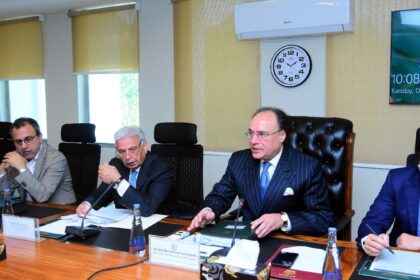



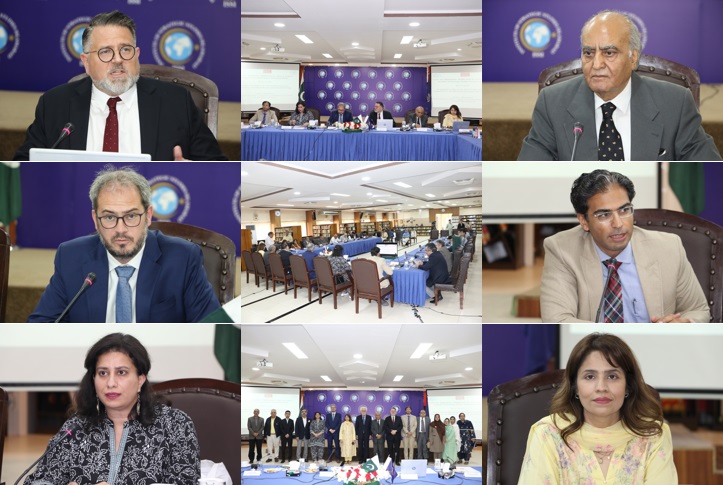
The Centre for Afghanistan, Middle East & Africa at the Institute of Strategic Studies Islamabad hosted the launch of Marc Saxer’s book Geopolitical Conflict in the Wolf World, Great Power Competition and the Illiberal Revolt against the Liberal Order, drawing diplomats, academics, students and civil society practitioners to discuss implications for Pakistan.
Ambassador Khalid Mahmood said Mr. Saxer’s analysis offers a clear reading of an international system in flux, noting the book highlights intensifying great power competition, geoeconomic rivalry and the erosion of the liberal international order. He stressed that the concept of a Wolf World and the book’s call for strategic, pragmatic engagement and diversified partnerships are particularly relevant to Pakistan’s foreign policy choices.
Dr. Amina Khan pointed to the book’s assessment of declining multilateralism and rising multipolarity, underlining how geopolitical and geo-economic tensions are reshaping global alignments. She said the themes in the book underscore the need for Pakistani policymakers to adapt to changing global governance dynamics.
Mr. Felix Kolbitz described Pakistan as being at the intersection of major geopolitical shifts and called the book a rigorous map of forces shaping today’s world order. He argued that understanding the contours of a Wolf World is urgent for Pakistan as regional and international flux increases.
Marc Saxer outlined the key arguments of his book, warning that the decline of the liberal international order, growing geoeconomic fragmentation and intensifying rivalry among major powers are moving the world away from an era driven by open markets to one shaped by strategic competition and economic security. He highlighted contestation in Europe, the Middle East and East Asia and said no single power can currently impose a new order, making dialogue and negotiated compromise essential to manage instability in a multipolar environment.
Ms. Aiza Azam praised the book as a timely and objective analysis, saying the Wolf World concept captures the realities of rising great power competition and an expanding role for non-Western and middle powers in global governance. She welcomed the book’s call for a more inclusive and balanced international order.
Dr. Vaqar Ahmed highlighted the book’s discussion on middle-power partnerships and the future of the international monetary system, arguing that strategic autonomy requires broader partnerships beyond defence spending. For Pakistan, he identified three lessons emphasised in the discussion: the need for macroeconomic stability in a fragmented global economy, the importance of deepening multiple strategic partnerships, and the necessity of remaining an active voice as global rules erode in ways that often disadvantage smaller and middle powers.
The event, organised by CAMEA at ISSI, brought together policymakers and civil society to consider how ideas in the book translate into policy for Pakistan, with participants noting that engagement, economic resilience and diversified partnerships will be central as the world adjusts to a Wolf World.