Pakistan Budget 2026–27: A Roadmap for Economic Stability and Public Prosperity
Professor Nadeem Iqbal

Pakistan stands at a critical economic juncture where inflation, unemployment, declining industrial activity, and weak public confidence continue to challenge national progress. In this situation, the Federal Budget 2026–27 must go beyond routine financial planning and emerge as a people-centered and growth-oriented roadmap for economic stability and prosperity.
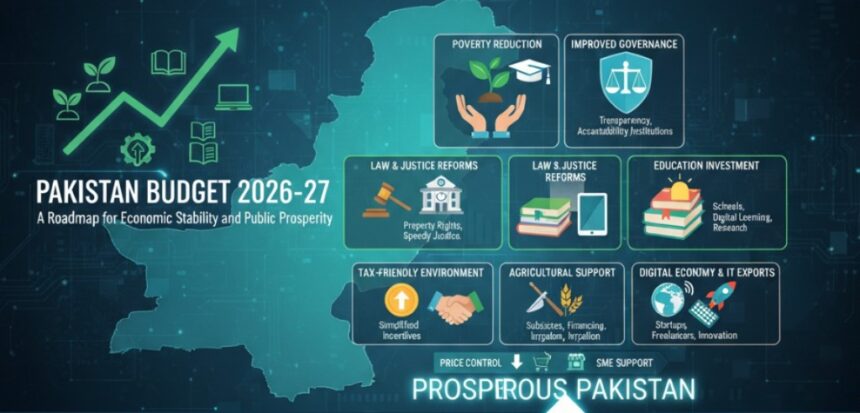
One of the most important priorities of the upcoming budget should be poverty reduction through skill development and employment generation. The government should establish technical and vocational training centers at the Union Council level so that young people, particularly in rural areas, can acquire modern and market-oriented skills. A skilled youth population can become a powerful engine for productivity, innovation, and economic growth.
At the same time, improving governance is essential. Efficient institutions, transparency, accountability, and merit-based systems are necessary to restore public confidence and ensure effective implementation of policies. Strong governance also strengthens investor confidence and creates a stable economic environment.
Law and justice reforms must also be prioritized. Investors and businesses can only operate with confidence when there is rule of law, protection of property rights, and timely justice. Judicial reforms, speedy dispute resolution, and modernization of the legal system would significantly improve Pakistan’s business climate.
Education should receive a larger share of the national budget. Investment in schools, universities, teacher training, digital learning, and research is critical for long-term national development. Nations that invest in education ultimately achieve stronger economies and social stability.
The government should also create a tax-friendly environment for businesses and investors. Excessive taxation and policy uncertainty discourage both local and foreign investment. Investors’ trust must be restored by ensuring stable economic policies, simplified tax procedures, and incentives for industries, exporters, and entrepreneurs. Economic growth cannot be achieved without strong private sector participation.
Special attention must be given to agriculture, which remains the backbone of Pakistan’s economy. Farmers should be provided with subsidies on seeds, fertilizers, electricity, and agricultural machinery. Affordable financing and better irrigation facilities should also be introduced. A prosperous farmer means a prosperous Pakistan. When farmers are financially stable, agricultural production increases, food security improves, rural poverty declines, and the overall economy becomes stronger.
The budget should further focus on controlling electricity, fuel, and essential commodity prices. High energy costs increase inflation and reduce industrial competitiveness. Affordable electricity and stable fuel prices would provide relief to households while supporting businesses and manufacturing sectors.
Support for small and medium enterprises (SMEs) is equally important. SMEs generate employment and economic activity across the country. Easy access to loans, lower taxes, and reduced bureaucratic hurdles can help small businesses expand and contribute more effectively to the economy.
Pakistan must also invest aggressively in the digital economy, IT exports, and entrepreneurship. Freelancers, startups, and technology-based businesses have immense potential to generate foreign exchange and create employment opportunities for youth. Encouraging innovation and digital infrastructure can transform Pakistan into a competitive regional economy.
In conclusion, Budget 2026–27 should focus on restoring public confidence, strengthening investor trust, empowering farmers, improving governance, and investing in education and skills. If the government adopts practical and people-oriented policies, Pakistan can move toward sustainable economic growth, social stability, and national prosperity.