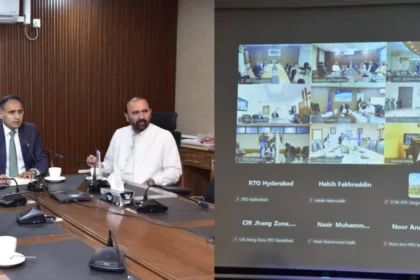




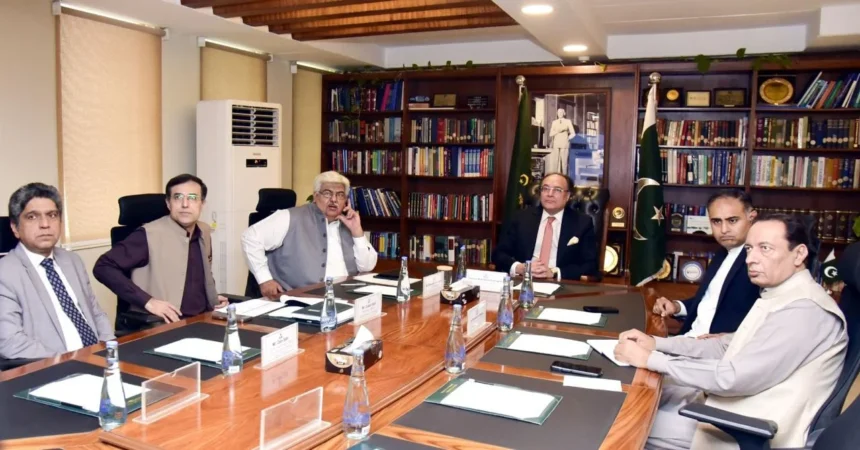
ISLAMABAD: Federal Minister for Finance and Revenue Senator Muhammad Aurangzeb on October 9 chaired a meeting at the Finance Division to review progress on the retailers’ tax scheme and discuss measures to facilitate registration and broaden the tax base.
The meeting was attended by the Minister of State for Finance, Chairman Federal Board of Revenue (FBR), and senior FBR officials.
The finance minister said the government was making efforts to simplify tax procedures and facilitate retailers in fulfilling their tax obligations. He said the scheme provided a simplified route for retailers to become part of the formal tax system and contribute to the country’s economic development.
The meeting reviewed progress on registrations and tax returns under the scheme, including the participation of existing taxpayers and the applicable requirements for tax payments. Senator Aurangzeb stressed the need to assess the implementation experience and address operational matters to make the scheme a success.
The meeting also discussed efforts to identify and map unregistered retailers through available data and relevant identification records. The FBR briefed the meeting on data validation and the need to ensure that registration records accurately reflected the businesses concerned.
The finance minister called for a balanced, targeted and well-documented approach to taxpayer facilitation. He said the retailers’ tax scheme should not be viewed as a one-year arrangement limited to 2026, adding that it was intended to provide a simplified route for small retailers to enter and remain within the formal tax system in the years ahead.
The meeting further reviewed filing procedures, deadlines and related operational matters. It reaffirmed the importance of making tax compliance simpler and more accessible for small retailers while progressively documenting economic activity and broadening the tax base. The minister said sustained progress would require effective facilitation and a consistent approach.
Separately, Senator Muhammad Aurangzeb hosted a luncheon for a business delegation from the Netherlands visiting Pakistan under the leadership of the Founders Carbon Network (FCN). Ambassador of the Kingdom of the Netherlands to Pakistan Mr Robert Jan Siegert accompanied the delegation.
The luncheon was also attended by the Adviser to the Prime Minister on Privatisation, the Governor State Bank of Pakistan, the Secretary Commerce and senior officials of the Finance Division.
Welcoming the delegation, the finance minister appreciated its interest in Pakistan and underlined the importance of strengthening business linkages, mutual understanding and bilateral economic cooperation. He said sustained engagement between the business communities of Pakistan and the Netherlands would help identify commercially viable investment opportunities, develop partnerships and enhance investor confidence.
Senator Aurangzeb highlighted Pakistan’s improving economic outlook and said the gains from macroeconomic stability needed to be translated into productive investment, capital formation, export growth and private-sector-led development. He said the next phase of growth should be based on exports, productivity gains and new employment opportunities, supported by continued structural reforms and greater mobilisation of private capital.
The minister also highlighted the government’s key economic priorities, including consolidating macroeconomic stability, strengthening fiscal and external sector resilience, moving towards sustainable, inclusive and responsible growth, implementing structural reforms, shifting from aid to trade and investment, expanding access to finance for small and medium enterprises, agriculture, housing and underserved segments, and benefiting from digitisation and emerging technologies.
He said Pakistan’s foreign exchange reserves had risen to a historic high of $21.4 billion, sufficient for around three months of imports. He said sustaining these achievements and strengthening the economy against external shocks were necessary for investor confidence and sustainable economic growth.
The finance minister described rapid population growth and climate change as two major existential challenges for Pakistan. He said both factors affected economic sustainability, human development and long-term resilience, requiring continued policy focus and coordinated reforms.
Discussing cooperation between Pakistan and the Netherlands, Senator Aurangzeb said Dutch expertise, technology and investment could complement Pakistan’s development priorities. He termed public-private partnerships important for mobilising private capital, benefiting from specialised expertise and translating investment interest into commercially viable projects.
The Adviser to the Prime Minister on Privatisation reiterated the government’s commitment to increasing private-sector participation through privatisation and public-private partnerships. He said these measures were aimed at improving efficiency, attracting investment and creating opportunities for the private sector in commercial activities.
The Governor State Bank of Pakistan highlighted the importance of macroeconomic stability, external sector strength and financial sector reforms in supporting productive activity. He also referred to trade facilitation and termed the role of the Trade Facilitation Board important in addressing trade barriers and strengthening coordination among institutions.
The Netherlands business delegation shared its views on the business environment in Pakistan and bilateral cooperation. The meeting discussed ways to strengthen business linkages, identify areas of mutual interest and develop practical partnerships.
The interaction highlighted the shared interest of Pakistan and the Netherlands in converting closer business ties into investment, trade and long-term economic partnership. The government also reaffirmed its commitment to providing a conducive environment for international investors and promoting greater private-sector participation in Pakistan’s economic development.