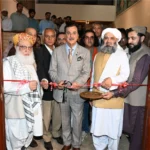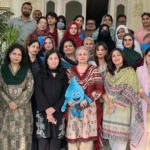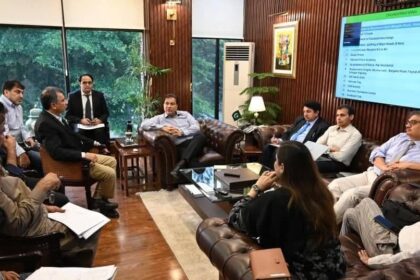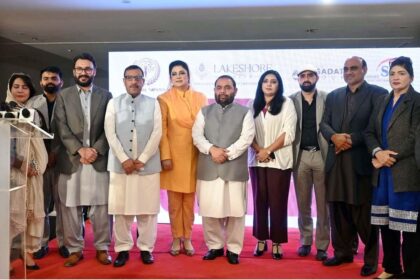




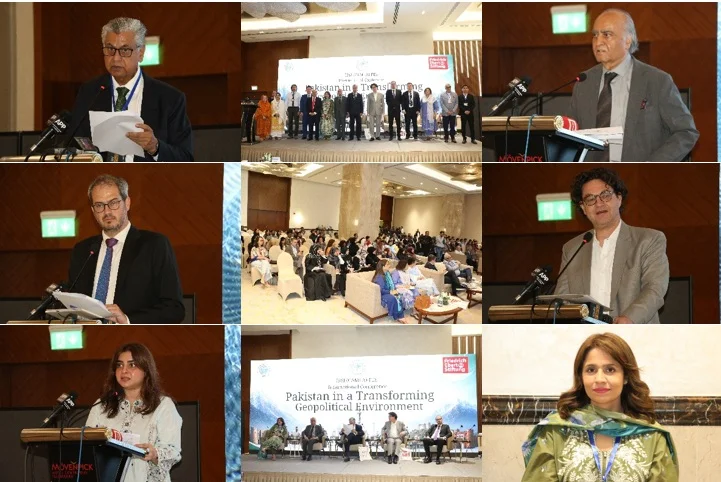
The Centre for Afghanistan, Middle East and Africa (CAMEA) at the Institute of Strategic Studies Islamabad (ISSI), in collaboration with Friedrich Ebert Stiftung (FES), Pakistan office, hosted a one-day international conference titled “Pakistan in a Transforming Geopolitical Environment”.
Murtaza Solangi, Spokesperson for the President of Pakistan, was the chief guest at the inaugural session. The speakers included Dr Amina Khan, Director CAMEA; Ambassador Khalid Mahmood, Chairman, Board of Governors, ISSI; Felix Kolbitz, Country Director, FES Pakistan; and Arno Kirchhof, Charge d’Affaires, Embassy of the Federal Republic of Germany, Islamabad.
In his welcome remarks, Ambassador Khalid Mahmood said Pakistan was situated in a rapidly changing regional and global environment where strategic competition was intensifying, regional alignments were shifting and conflicts were producing wider political and economic consequences.
He said the line between traditional and non-traditional security challenges was becoming increasingly blurred. For Pakistan, he added, these developments were not abstract as they directly affected the country’s security, economy, diplomacy and regional outlook.
Ambassador Mahmood said Pakistan’s location gave it strategic importance but also placed on it the responsibility to pursue a balanced, thoughtful and forward-looking foreign policy. He said Pakistan’s approach had consistently been based on dialogue, peaceful coexistence, respect for sovereignty, regional stability, economic cooperation and connectivity.
In her introductory remarks, Dr Amina Khan said the annual CAMEA-FES conference continued to promote deeper dialogue and understanding of shared challenges and evolving regional dynamics. She said Pakistan was located in what had often been described as a “tough neighbourhood”.
She said the region continued to face a complex mix of traditional and non-traditional security challenges, compounded by geopolitical rivalries, great-power competition and protracted conflicts. At the same time, she said, the region possessed enormous potential for connectivity, economic integration and shared prosperity.
Dr Khan said that at a time of profound geopolitical transformation, sustained dialogue and regional cooperation remained indispensable for building trust, advancing connectivity and promoting lasting peace and shared prosperity.
Addressing the conference, Murtaza Solangi said the event was timely and important as it brought together experts from across the world at a consequential moment. He said the world was witnessing a transition from a unipolar to a multipolar order, while the order created after the Second World War was collapsing and major global powers were creating their own spheres of interest.
He said Pakistan was at the intersection of several transitions, including unsettled Pakistan-Afghanistan relations and a fast-moving global order. He described the present period as among the most consequential years for Pakistan.
Mr Solangi said developments including last year’s India-Pakistan war and the continued conflict between the United States and Iran affected Pakistan. He said Pakistan maintained good ties with the Gulf Cooperation Council, China and the United States, and had tried to reposition itself and bring peace to a volatile region.
He said Pakistan sought a peaceful and stable relationship with Afghanistan and had historically stood with the Afghan people. He added that Pakistan would not like to see Afghanistan become a global sanctuary for terrorism. He welcomed China’s, Turkiye’s and Qatar’s mediation with regard to Pakistan’s relationship with Afghanistan.
Mr Solangi said Pakistan was also interested in trans-regional connectivity. He said Pakistan’s defence pact with Saudi Arabia was part of the country’s broader agenda of improving relations with the GCC, and that Pakistan had a sound relationship with Iran.
He said security had become transformative and Pakistan faced numerous challenges, including pandemics, natural disasters and other issues. He concluded that Pakistan’s foreign policy rested on strategic balance with regional neighbours and proactive diplomacy.
Arno Kirchhof presented the European Union as an example to express optimism regarding the functionality and sustainability of a rules-based world order, despite persistent challenges. He identified key areas in which Pakistan could establish and strengthen its partnership with Germany and other European countries. He also stressed the need to further enhance trade, investment and human resource exchange between Pakistan and Germany.
In his remarks, Felix Kolbitz applauded Pakistan’s recent global diplomatic manoeuvring in the region and beyond as remarkable. He said that with the brokering of a peace deal between Iran and the United States and the conclusion of a defence agreement with Saudi Arabia, Pakistan had emerged as a net security provider for the region.
Referring to Pakistan’s unique geography, he identified several key challenges facing the country, including water and climate security and transnational terrorism. He said these were shared challenges requiring a collective strategy and a shared response by the global community.
The conference schedule included three working sessions: “Afghanistan, Central Asia and the Future of Regional Stability”; “Pakistan and the Middle East in a Transforming Geopolitical Environment”; and “Non-Traditional Security Challenges Across a Changing Regional Landscape”.