



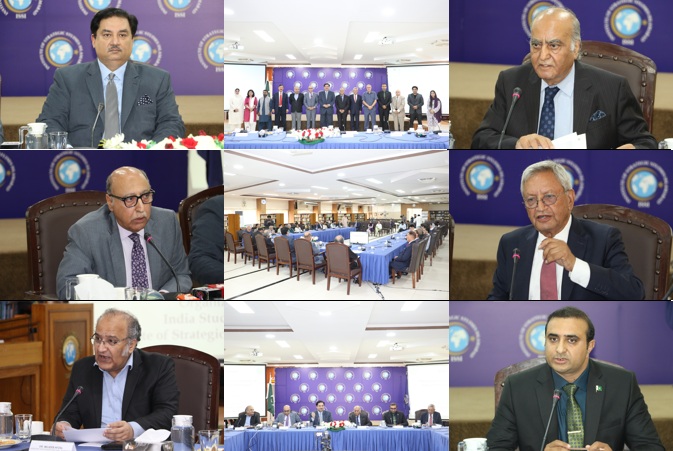
The India Study Centre at the Institute of Strategic Studies, Islamabad convened a seminar that brought together senior diplomats, academics and policy practitioners to examine Pakistan India Relations and the road ahead for bilateral engagement.
Ambassador Khalid Mahmood opened the session by noting that ties between the two countries have alternated between conciliation and confrontation. He said New Delhi’s attempt to diplomatically isolate Pakistan has not worked as intended and some voices in India are now reconsidering their Pakistan strategy. At the same time he warned that India’s military rhetoric remains a source of risk and urged Islamabad to be cautious, favouring a structured dialogue over hasty engagement.
The chief guest, Engineer Khurram Dastgir Khan (HI), argued that Pakistan has derived three strategic advantages from recent regional tensions including warmer ties with the United States, growing international legitimacy and demonstrated capacity to conduct complex diplomacy. He urged that these strengths be leveraged in dealing with India but cautioned that deep obstacles persist such as the unresolved Jammu and Kashmir dispute, mutual allegations of cross-border terrorism, rising domestic nationalism in India, the nuclear dimension and friction over the Indus Water Treaty. He highlighted water sharing as a particularly dangerous flashpoint.
Dr Khurram Abbas described the bilateral relationship as one of the most-watched in the world and said the current period may be the worst in recent memory because even settled issues like water-sharing have become prone to hostility. He called on academics, civil society and policy practitioners to cultivate the appetite for peace and help both countries find a path out of the current stalemate.
Ambassador Abdul Basit expressed scepticism about Indian initiatives for engagement and warned that the timing may not be conducive to a breakthrough from New Delhi’s perspective. He recommended that Pakistan prioritise its national interests and long-term objectives and that confidence building measures must be accompanied by a clear mechanism to address core issues including Jammu and Kashmir.
Dr Manzoor Ahmed warned that one of the clearest casualties of the crisis has been trade. He noted that the ban on direct trade with India forces reliance on indirect routes, inflating import costs. Citing a World Bank study, he said Pakistan could capture substantial export gains if trade barriers were eased and urged policymakers to decouple commercial ties from political disputes to deliver economic benefits.
Dr Mujeeb Afzal reviewed the historical narratives around Jammu and Kashmir and argued that the dispute is embedded in national identities on both sides, which raises the cost of compromise. He added that India’s decision to place the Indus Waters Treaty in abeyance complicates an already fraught relationship and makes durable engagement more difficult.
The seminar concluded with a rigorous question and answer session that reflected both caution and the search for practical pathways. Across interventions speakers converged on the need for measured, structured diplomacy, protection of economic interests and vigilance over water and security flashpoints as Pakistan and India navigate a fragile trajectory.