




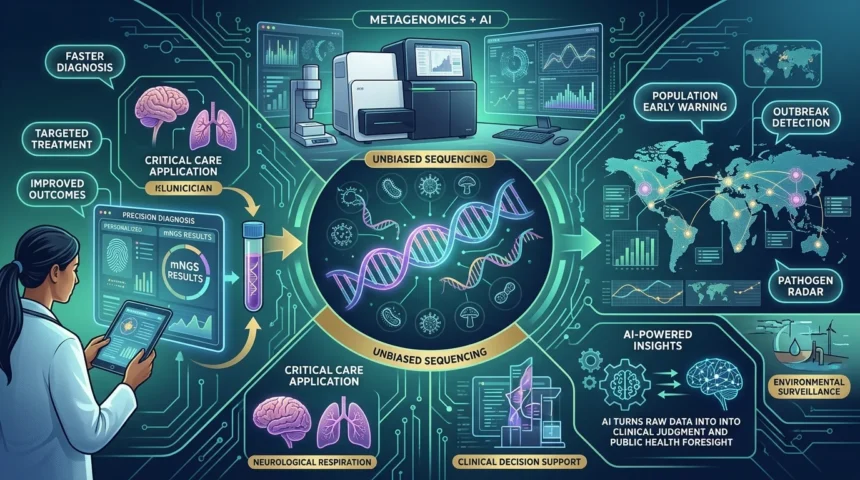
The technology that helped identify SARS-CoV-2 in late 2019 is now changing how doctors diagnose difficult infections and how public-health systems monitor possible outbreaks.
Metagenomic next-generation sequencing, or mNGS, is an unbiased method that sequences nearly all genetic material in a sample. When combined with artificial intelligence, it is moving from research laboratories into intensive-care units, specialty hospitals and national surveillance networks.
The approach marks a shift from testing for a suspected pathogen to detecting almost any known or novel microbe. It can also help read the patient’s own immune response to assess whether a detected organism is actually causing disease.
In neurological emergencies, such as patients arriving with fever, confusion, headache or weakness, doctors often face difficult decisions. Meningitis or encephalitis may be caused by a virus, bacterium, fungus or an autoimmune attack on the brain or spinal cord. Treatment choices can differ sharply, with antimicrobials used for infection and immune-suppressing drugs used for autoimmunity.
Conventional tests may return negative, while delays can affect outcomes. Metagenomic sequencing of cerebrospinal fluid has shown particular value in such cases.
Long-term data from the University of California, San Francisco clinical laboratory, covering nearly 5,000 samples over seven years, showed that mNGS detected organisms in about 14 per cent of cases. It identified infections missed by standard testing in roughly one-fifth of confirmed central-nervous-system infections.
Earlier prospective work found that mNGS alone diagnosed about 22 per cent of infections and influenced treatment decisions in a meaningful subset of those cases.
The method has also helped uncover hepatitis E virus in a patient previously thought to need a liver transplant, and detect tuberculosis that had been mistaken for lung cancer and had nearly led to major surgery.
Similar gains have been reported in respiratory and critical-care settings. Same-day pan-microbial metagenomics introduced for children in intensive care at Great Ormond Street Hospital changed clinical management in nearly 30 per cent of samples and influenced antibiotic decisions in about a quarter of cases. It also uncovered dozens of organisms missed by routine tests.
Broader reviews of prospective studies show the strongest impact in critically ill patients with lower-respiratory-tract infections, central-nervous-system disease and sepsis, where conventional diagnostics often leave major gaps.
For immunocompromised patients, including transplant recipients, cancer patients and those on immunosuppressive therapy, ordinary infections can quickly become life-threatening. With hundreds of possible pathogens, sequential testing can be slow and incomplete. Metagenomics offers a single-assay approach that can detect bacteria, viruses, fungi and parasites at once.
However, raw metagenomic output is complex. Human DNA dominates most samples, common colonisers and laboratory contaminants may appear frequently, and not every microbe detected is responsible for illness. Earlier versions of the technology could take days or even a week to produce results.
Faster sequencers now generate data in hours. AI and machine-learning models can speed up host-sequence depletion, organism classification, detection of highly divergent or novel microbes, antimicrobial-resistance gene flagging and ranking of detections most likely to be pathogenic.
Some approaches also examine host gene expression, or the proteins a patient’s cells are making. This can help distinguish an active immune response against a pathogen from colonisation or contamination. Such information supports more precise treatment decisions for individual patients.
The combination is also supporting antimicrobial stewardship. It can help clinicians de-escalate unnecessary broad-spectrum drugs when no pathogen is found, or escalate treatment precisely when an unexpected organism is identified.
The same sequencing data used for patient care can also support public-health surveillance. In the United Kingdom, the mSCAPE programme links anonymised metagenomic results from NHS respiratory networks with national health-security systems, creating a real-time pathogen monitoring system.
Results that previously took days can now inform clinicians in about six hours while also updating surveillance databases for novel or rising threats.
Wastewater and environmental metagenomics are expanding surveillance further. Studies of sewage from dozens of cities across continents have mapped urban viromes, detected early signals of circulating viruses and, in some historical cases, identified SARS-CoV-2 genetic material months before the first clinical diagnoses.
Similar approaches are being explored for other pathogens and antimicrobial-resistance genes circulating in communities. When clinical and environmental data are combined with AI pattern recognition, the potential for earlier outbreak detection increases.
Adoption is accelerating in hospitals in the United Kingdom, the United States and elsewhere, where rapid respiratory and neurological metagenomics are being embedded into care pathways. Commercial assays able to detect more than a thousand bloodstream pathogens from cell-free DNA are entering markets. Regulatory interest is also rising, with some platforms receiving breakthrough-device designations.
Important challenges remain. Cost and turnaround time still limit routine first-line use in many settings. Interpreting incidental findings requires clinical context and clear reporting standards. Regulatory systems designed for targeted tests do not always fit agnostic sequencing, complicating wider authorisation and reimbursement.
Standardisation of laboratory methods, bioinformatics pipelines and quality metrics is still incomplete. Equity is another concern, as high-resource centres are benefiting most at present, while lower-resource regions with heavy infectious-disease burdens may fall behind without investment in accessible platforms and training.
Ethical questions also remain. These include whether every incidental microbe should be reported and how clinicians should handle detections of pathogens for which no specific treatment exists. Clear guidelines, drawing on lessons from human genomics, will be needed as the technology expands.
Metagenomics combined with AI is therefore more than a better diagnostic test. It changes the central question from whether a specific pathogen is present to what is present, whether it is causing harm and what response is best for the patient and the wider population.
The Covid-19 pandemic showed the importance of rapid, unbiased pathogen discovery. Since then, the same tools have been refined and accelerated for everyday care in meningitis, pneumonia, sepsis and unexplained fever, while also strengthening early-warning systems for future outbreaks.
The technology is still maturing, and wider access will require lower costs, more automated interpretation and stronger standardisation. But infectious-disease medicine is moving towards a more precise, comprehensive and proactive model, with patients facing the most complex infections already among the beneficiaries.