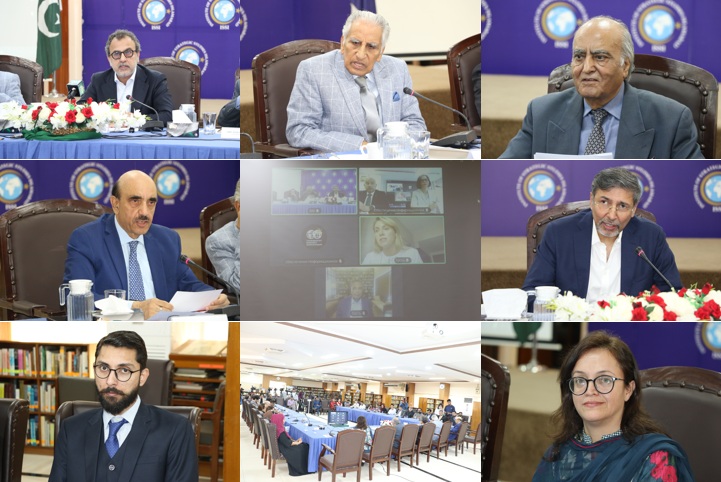
Pakistan Russia ties took centre stage at a high-level webinar organised by the Institute of Strategic Studies Islamabad in collaboration with the University of World Civilizations, Moscow on June 9, 2026, bringing together senior policymakers, diplomats, scholars and media professionals to assess evolving bilateral cooperation amid a shifting global order.
Dr Neelum Nigar, Director of the Centre for Strategic Perspectives at ISSI, set out the event’s objective to deepen strategic understanding while strengthening public diplomacy, academic exchanges, media cooperation and people-to-people contacts between Pakistan and Russia.
Federal Minister for Energy Sardar Awais Ahmed Khan Leghari described bilateral relations as steadily strengthening over the past two decades, highlighting expanded cooperation across energy, trade, industry, defence, education, science and technology and people-to-people exchange. He pointed to increasing high-level engagement, the work of the Pakistan–Russia Intergovernmental Commission, coordination through the United Nations and the Shanghai Cooperation Organisation, and discussions on Pakistan’s participation in the International North-South Transport Corridor and its potential linkage to Gwadar Port alongside the Programme of Economic Cooperation up to 2030.
Pakistan’s Ambassador to the Russian Federation, Ambassador Faisal Niaz Tirmizi, said the current period is a defining moment in international politics as Moscow gains influence in emerging geopolitical and economic trends. He emphasised that connectivity projects, economic cooperation and political coordination are likely to further consolidate Pakistan Russia ties and contribute to a more inclusive regional order.
In a wide-ranging discussion, Special Assistant to the Prime Minister Ambassador Syed Tariq Fatemi described relations as being at their strongest point in history with growing convergence on regional and global issues. Former President of Azad Jammu and Kashmir Ambassador Masood Khan and other speakers placed bilateral engagement in the context of Eurasian geopolitics and an emerging multipolar world, underlining the potential to advance connectivity, energy security, trade integration and counterterrorism cooperation while calling for stronger economic engagement with China and Central Asian states.
Speakers from Moscow, including Dr Natalia Zamaraeva and Dr Roxolana Zigon, noted increasing momentum in economic connectivity, transport corridors, energy cooperation, educational exchanges and institutional partnerships, describing the relationship as entering a new phase of strategic trust that requires sustained dialogue and academic collaboration.
The second session focused on societal and informational linkages, with Russian media expert Dimitri Alexander Simes urging expanded journalistic exchanges and institutional collaboration to improve mutual narratives. Senior Pakistani journalist Syed Talat Hussain emphasised cultural diplomacy and the need for enhanced cooperation in education, tourism and cultural exchanges, while analysts like Leonid Savin and broadcaster Tanya Juliet Francis highlighted the role of universities, cultural organisations and media partnerships in translating official momentum into lasting people-to-people ties.
Ambassador Khalid Mahmood, Chairman Board of Governors ISSI, closed the webinar by reflecting on emerging geopolitical trends, regional connectivity initiatives, energy cooperation and media engagement, reaffirming both sides’ commitment to sustained dialogue and expanding cooperation across multiple domains to bolster Pakistan Russia ties.