



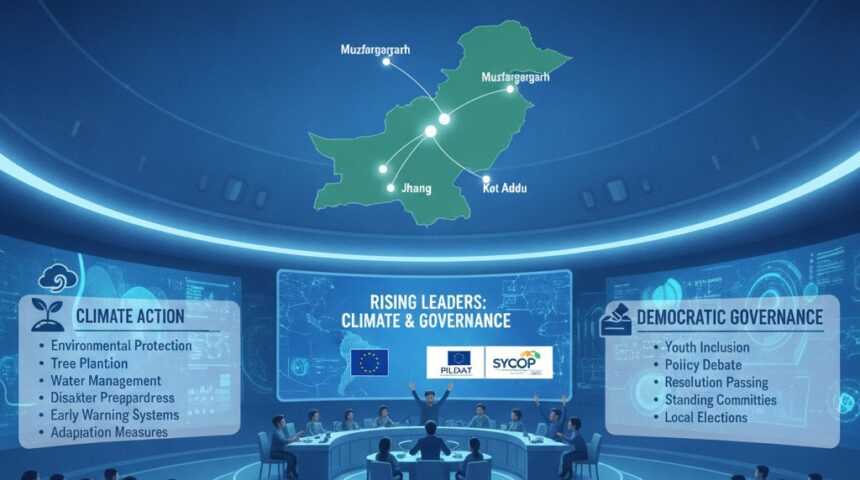
Nearly 200 young people from South Punjab convened in Multan from 4 to 11 June to examine climate, governance and development challenges facing their districts and to build the skills needed to engage public institutions. Delegates from District Youth Assemblies in Muzaffargarh, Layyah, Jhang and Kot Addu took part in parliamentary-style debates, expert dialogues and practical training designed to strengthen youth voice in local decision making.
The sessions form part of the three-year action Rising Leaders: Youth in Climate Leadership & Governance co-funded by the European Union and implemented by the Pakistan Institute of Legislative Development and Transparency and the Social Youth Council of Patriots. Each District Youth Assembly of 50 members attended a focused two-day programme on 10 and 11 June that combined civic education, formal voting exercises and digital skills training alongside policy debate.
On 10 June participants explored how climate change is affecting their districts. Policymakers and disaster management specialists joined interactive discussions on riverine flood risks, early warning systems and long-term adaptation. Addressing the assembly, Mr. Muhammad Ajmal Khan Chandia MPA and Parliamentary Secretary for Higher Education stressed that youth must take an active role in environmental protection, tree plantation, efficient water management and disaster preparedness. Mr. Irfan Sial, Coordinator District Disaster Management Authority Muzaffargarh, and Mr. Karamat Ali, Coordinator DDMA Layyah, drew on frontline experience to explain flood emergency response and practical adaptation measures.
On 11 June the programme shifted to practical civic engagement skills. Participants received training on filing Right to Information requests, engaging with Standing Committees and preparing to contest or participate in local government elections. The sessions underscored that democratic participation extends beyond voting and that youth have concrete tools to hold institutions accountable and advocate for community priorities.
The focus on climate leadership was reinforced throughout the week as young leaders debated policy options and passed resolutions calling for stronger youth inclusion in local governance. Mr. Jeroen Willems Head of Cooperation at the European Union Delegation to Pakistan noted that young people in South Punjab are among those most affected by climate change and highlighted the EU commitment to inclusive participatory governance through support for the initiative.
Participants left Multan with enhanced knowledge of Pakistan’s democratic structures, clearer pathways to engage provincial and local institutions and practical skills to press for climate resilient planning in their districts. The programme aims to convert that momentum into sustained youth-led action at the local level across South Punjab.