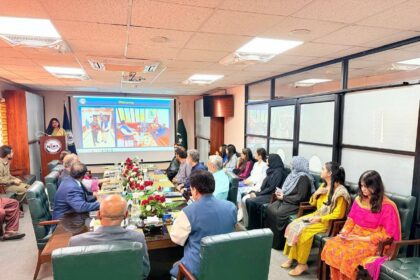




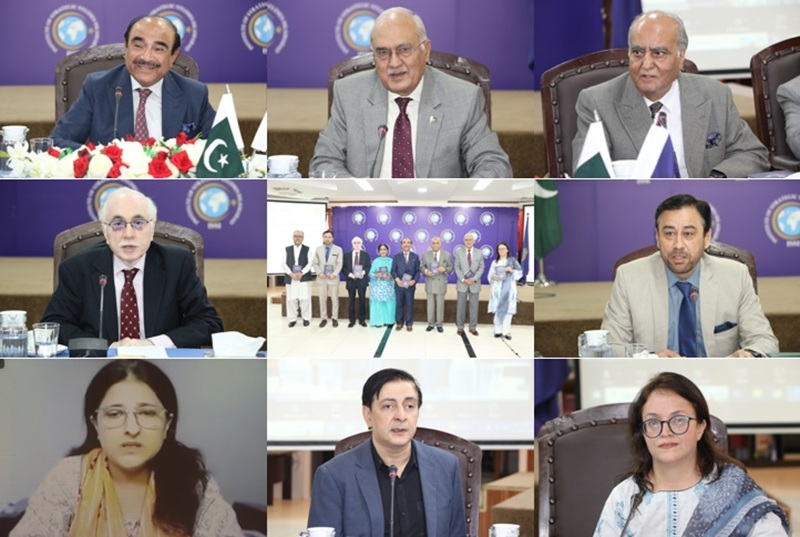
The Institute of Strategic Studies Islamabad hosted the launch of the book The Third Dimension Policy Prism authored by Ambassador G. R. Baluch, drawing diplomats, academics, scholars and media to discuss its implications for Pakistan and global affairs.
Dr. Neelum Nigar, Director of the Centre for Strategic Perspectives at ISSI, welcomed the gathering and thanked Ambassador Baluch for entrusting the institute with the launch. She underlined the value of such scholarly contributions in fostering informed debate on foreign policy.
Ambassador Khalid Mahmood described the work as timely and notable for blending diplomatic experience with academic reflection. He said contemporary international relations require a multidimensional approach that accounts for geopolitical competition, technological disruption, economic realignments, climate change, information flows and non-state actors, and noted that the book’s perspective aligns with that urgent need.
Introducing his book, Ambassador G. R. Baluch framed the present era as a battle of narratives in which ideas and discourse shape influence. He characterized the volume as more of a conversation than a conventional text and stressed how ideas move from pages into policy. The author encouraged continued dialogue on foreign policy and international affairs.
General Khalid Naeem Lodhi highlighted the central concept of the Third Dimension as an expansion of strategic thinking to include ethics and humanity alongside national interest. He noted that the book’s five chapters survey multiple regions, examine Pakistan’s relations, address divisions within the Muslim Ummah, assess developments in the Middle East and the Gaza crisis, and frame contemporary challenges through the three Cs of conflict, cooperation and consensus while stressing the rising role of technology in diplomacy and strategic competition.
Ambassador Masood Khalid called the collection a valuable and accessible set of essays that link global developments to Pakistan’s national interests. He praised its treatment of South Asia, including reflections on India’s posture during Operation Sindoor and the strategic implications, and its assessment of the humanitarian and geopolitical dimensions of the Gaza conflict.
Dr. Munawar Hussain observed that the author views international politics through material and value-based lenses, arguing that values and ideology remain central to how societies act. He welcomed the book’s engagement with narrative-making and theory construction and its emphasis on multilateralism as a response to contemporary global challenges.
Dr. Shazia Khalid Cheema noted the book’s attention to symbolic, moral, psychological and cultural dimensions that shape political identities, stressing how stories, media discourse and historical memory influence perception and meaning in geopolitics.
Farukh Pitafi said the book speaks to both diplomats and academics, combining policy relevance with conceptual depth. He described its readable structure across thematic chapters on South Asia, the Middle East, great power shifts and global politics, and highlighted its humanistic threads on education, artificial intelligence and changing learning environments.
The launch concluded with the formal unveiling of the book and distribution of souvenirs to the speakers, leaving participants with material for further reflection on the Third Dimension and its implications for Pakistan’s foreign policy and strategic thinking.