
Overseas Pakistanis Exploited by Private Job Promoters While Their Properties Face Encroachment
Nadeem Tanoli
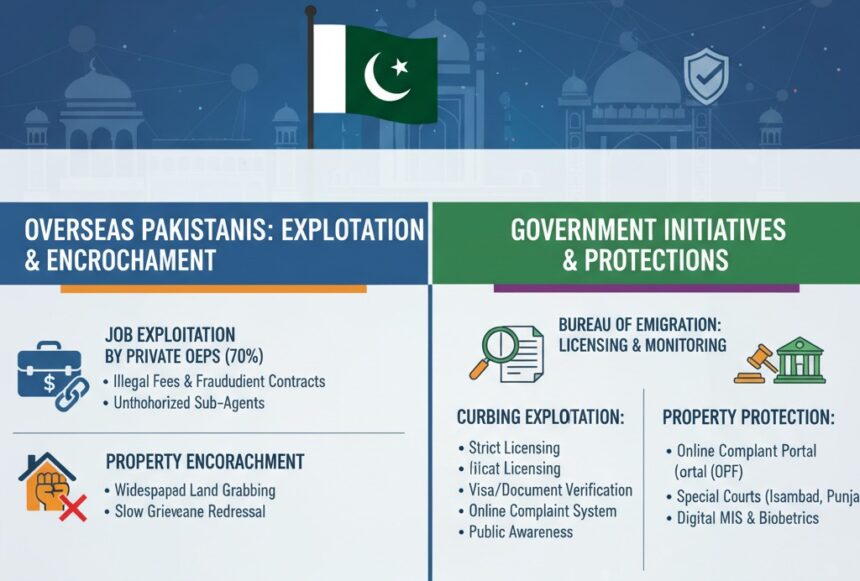
Islamabad: National Assembly disclosures have exposed serious vulnerabilities affecting overseas Pakistanis, including exploitation by private Overseas Employment Promoters (OEPs) and widespread property encroachments. Senator Natasha Daultana highlighted that a substantial portion of overseas employment continues to be handled by private OEPs, leaving Pakistani workers exposed to illegal fees, misleading contracts, and fraudulent recruitment practices, despite government oversight through the Emigration Ordinance, 1979.
Minister for Overseas Pakistanis and Human Resource Development, Chaudhary Salik Hussain, confirmed that the Bureau of Emigration & Overseas Employment regulates licensed OEPs to ensure lawful manpower export, but unauthorized sub agents continue to operate, putting thousands at risk. The government has expanded public sector recruitment through the Overseas Employment Corporation (OEC), increasing placements in Saudi Arabia from 452,562 in 2024 to 530,256 in 2025. Japan saw placements rise from 1,518 to 2,210 across IT, manufacturing, healthcare, and technical trades, while Italy’s Decreto Flussi programme offers 10,500 quotas for 2026 to 2028 in agriculture, construction, healthcare, hospitality, logistics, and ICT. The total overseas employment demand currently stands at approximately 140,688 vacancies, with 133,730 via private OEPs and 6,958 via OEC.
To curb exploitation, the government has implemented strict licensing, inspection, and monitoring mechanisms, including verification of visa and employment documents, scrutiny of demand letters, coordination with foreign missions, and action against violations such as FIR registration, license cancellation, forfeiture of security deposits, and refunds to affected emigrants. Public awareness campaigns educate citizens on legal recruitment channels, risks of illegal migration, and safe migration procedures. Centralized digital mechanisms, including an integrated Management Information System (MIS), biometric verification, computerized emigration clearance, and online complaint handling, are being implemented to monitor overseas employment end-to-end.
The session also addressed property encroachments affecting overseas Pakistanis. The Overseas Pakistanis Foundation (OPF) has developed an Online Complaint Management System (OCMS), linked with the Pakistan Citizen Portal (PCP), to streamline grievance redressal. Through this system, 11,223 officers from 6,285 departments including 86 embassies, high commissions, and consulates are connected to process complaints. Encroachment cases are forwarded to government housing authorities, district administrations, revenue departments, and law enforcement agencies for resolution. Key agencies involved include Punjab Police, Anti Corruption Establishment Punjab, the Criminal Control Department Punjab, and the Board of Revenue Punjab.
Special courts have been established to adjudicate property disputes. In Islamabad, benches at the High Court and designated Special Judges for East and West districts are operational under the Special Court (Overseas Pakistanis’ Property) Act, 2024. Punjab has enacted the Special Courts Act, 2025, with judges designated across all districts. Khyber Pakhtunkhwa has forwarded a draft bill for approval, Balochistan has enacted its Special Courts Act but not yet designated judges, and Sindh is deliberating a draft bill at the Chief Minister’s level.
Copied from: Overseas Pakistanis exploited by private job promoters while their properties face encroachment