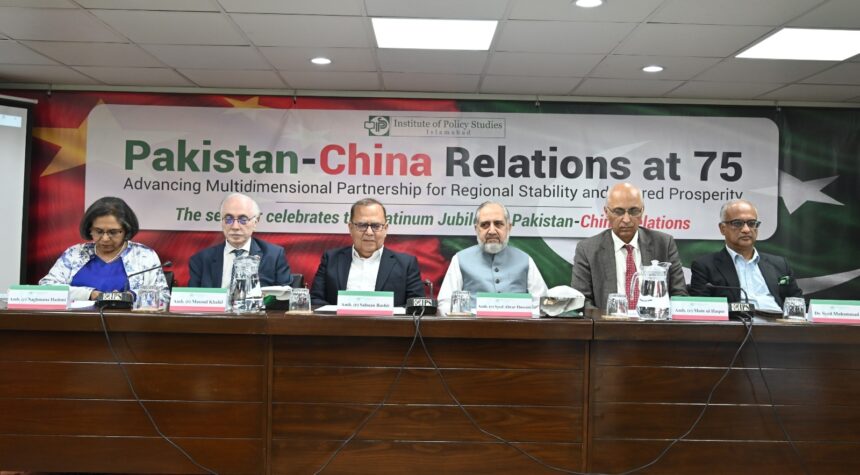
Speakers at a seminar in Islamabad stressed that Pakistan China interdependence is essential for the country’s multidimensional progress, urging a shift from dependence to reciprocal engagement across economic, technological and institutional fronts. The event at the Institute of Policy Studies marked 75 years of bilateral ties and brought together former envoys, security analysts and policy experts to map a future-oriented partnership.
Amb (r) Syed Abrar Hussain described the relationship as having evolved since 1951 into a deep strategic partnership, noting renewed momentum under both phases of CPEC. Amb (r) Masood Khalid recalled Pakistan’s early recognition of the People’s Republic of China and underlined that mutual trust, non-interference and shared interests have kept the ties resilient through regional and global challenges. He argued that China’s role as a stabilizing actor and CPEC’s geoeconomic potential could help transform Pakistan’s economy in the coming decade.
Amb (r) Naghmana Hashmi urged reorienting CPEC towards industrialization and special economic zones while expanding cooperation in AI, green technologies and rare earth minerals. She highlighted the strategic importance of operationalizing the ML-1 rail project and maximizing Gwadar port’s potential, stressing that trade deficits should be treated as a national security concern and that project implementation mechanisms require strengthening.
Amb (r) Moin ul Haque framed the friendship as a historic reality and conscious choice, suggesting Pakistan can learn from China’s state-led development model, provincial empowerment and investment in education, health and technology. He also noted that societal traits such as a focus on merit and disciplined effort have underpinned China’s development and offered lessons for Pakistan’s governance and human capital priorities.
Dr. Syed Muhammad Ali emphasized China’s critical contribution to Pakistan’s national power and regional balance, pointing to decades of unconditional support and strategic cooperation. He cited Chinese technological collaboration behind Pakistan’s indigenous military capabilities and highlighted Chinese-assisted civilian nuclear projects as important for addressing the country’s energy shortfalls. Referring to the May 2025 India-Pakistan military stand-off, he noted the operational effectiveness of modern Chinese defense technology.
Amb (r) Salman Bashir, delivering chair remarks, contrasted China’s long-term civilizational approach to relations with transaction-driven Western models, saying this perspective deepens bilateral resilience. Panelists collectively called for stronger governance, institutional professionalism and investment in skills to ensure Pakistan benefits equitably from deeper Pakistan China interdependence, while maintaining diversified international partnerships that complement ties with Beijing.
The seminar concluded with a consensus that translating strategic partnership into sustained socio-economic transformation will require policy shifts, better project delivery and an emphasis on people-to-people exchanges to solidify a future-focused, mutually beneficial relationship between the two countries.