




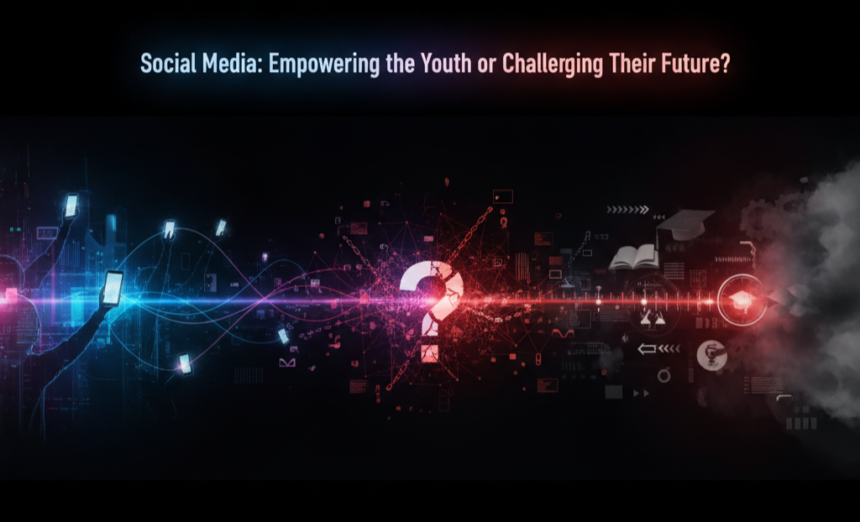
Social Media: Empowering the Youth or Challenging Their Future?

By Tasadduq Gilani
We are living in an era where a smartphone has become one of the most influential tools in shaping opinions, careers, relationships, and even national narratives. For today’s youth, social media is no longer just a platform for entertainment—it is a classroom, a marketplace, a networking hub, and a global stage. The real question is not whether social media is good or bad; rather, it is whether we are using it wisely.
Over the past decade, digital platforms have transformed the way young people learn, communicate, and build careers. Millions of students now access world-class educational content online. Entrepreneurs promote businesses without the need for large investments. Freelancers offer their expertise to international clients, and creators showcase their talents to audiences across the globe. In many ways, social media has democratized opportunity.
However, every technological revolution brings its own challenges. The same platforms that connect us can also isolate us. Endless scrolling often replaces meaningful learning. The pursuit of online validation has contributed to rising anxiety, stress, and declining self-esteem among many young people. Cyberbullying, misinformation, fake news, and digital addiction have emerged as some of the defining social challenges of our time.
Perhaps the greatest danger lies not in technology itself, but in the absence of digital wisdom. Information is available everywhere, but critical thinking is becoming increasingly rare. A viral post is not necessarily a truthful one, and popularity should never be confused with credibility. Young people must learn to verify facts, think independently, and engage responsibly before sharing information that can influence thousands of others.
The future belongs to those who create, not merely consume. Social media should be viewed as a platform to develop skills, share knowledge, build professional networks, promote innovation, and contribute positively to society. Every hour spent online should ideally move us closer to becoming more knowledgeable, more productive, and more valuable to our communities.
Parents and educators also have a critical role to play. Restricting technology alone is not the answer. Instead, families and educational institutions must promote digital literacy, ethical online behavior, emotional resilience, and balanced lifestyles. Young people need guidance, not just monitoring. They must be equipped to navigate the digital world with confidence, responsibility, and integrity.
As artificial intelligence, automation, and digital transformation continue to reshape the global economy, the ability to learn continuously, adapt quickly, and think critically will become more valuable than ever. Technology will continue to evolve, but timeless values—discipline, integrity, empathy, and wisdom—will remain the true foundations of success.
The responsibility before us is therefore clear. We must empower our youth not only with access to technology but also with the judgment to use it responsibly. Every click, every post, and every digital interaction contributes to shaping both individual futures and the future of society.
Social media is neither our greatest threat nor our greatest achievement. It is a mirror that reflects who we are and a tool that amplifies what we choose to become. If we choose knowledge over noise, purpose over popularity, and value over vanity, the digital age can become one of the greatest opportunities in human history.
The future will not be shaped by those who spend the most time online. It will be shaped by those who use technology to learn, innovate, inspire, and lead.
The choice is ours.